Structures algébriques#
L’algèbre n’est qu’une géométrie écrite, la géométrie n’est qu’une algèbre figurée.
Sophie Germain
Les structures algébriques abstraites permettent d’unifier et de généraliser des propriétés communes à des objets mathématiques très divers : entiers, polynômes, matrices, permutations…
Loi de composition interne#
Définition 26 (Loi de composition interne)
Soit \(E\) un ensemble. Une loi de composition interne (lci) est une application \(\star : E \times E \to E\). On dit que \(E\) est stable pour \(\star\).
Définition 27 (Propriétés d’une lci)
Soit \((E, \star)\) un magma.
Associativité : \(\forall x, y, z \in E,\ (x \star y) \star z = x \star (y \star z)\)
Commutativité : \(\forall x, y \in E,\ x \star y = y \star x\)
Élément neutre : \(\exists e \in E,\ \forall x \in E,\ e \star x = x \star e = x\)
Élément absorbant : \(\exists a \in E,\ \forall x \in E,\ a \star x = x \star a = a\)
Idempotence d’un élément : \(x \star x = x\)
Proposition 20 (Unicité de l’élément neutre et de l’absorbant)
Si un élément neutre existe, il est unique. Si un élément absorbant existe, il est unique.
Proof. Neutre : Soient \(e\) et \(e'\) deux neutres. Alors \(e = e \star e' = e'\) (car \(e'\) est neutre pour la première égalité, \(e\) pour la seconde).
Absorbant : Soient \(a\) et \(a'\) deux absorbants. Alors \(a = a \star a' = a'\) (car \(a'\) est absorbant).
Groupe#
Définition 28 (Groupe)
\((G, \star)\) est un groupe si :
\(\star\) est associative,
Il existe un élément neutre \(e\),
Tout élément \(x \in G\) admet un symétrique (ou inverse) \(x^{-1}\) tel que \(x \star x^{-1} = x^{-1} \star x = e\).
Un groupe est abélien (ou commutatif) si \(\star\) est commutative.
Proposition 21 (Propriétés dans un groupe)
Soit \((G, \star)\) un groupe d’élément neutre \(e\).
L’inverse est unique.
\((x^{-1})^{-1} = x\)
\((x \star y)^{-1} = y^{-1} \star x^{-1}\) (anti-automorphisme)
Régularité : \(a \star b = a \star c \implies b = c\) et \(b \star a = c \star a \implies b = c\)
Proof. 1. Si \(x'\) et \(x''\) sont deux inverses de \(x\) : \(x' = x' \star e = x' \star (x \star x'') = (x' \star x) \star x'' = e \star x'' = x''\). 2. \(x^{-1} \star x = e\), donc \(x\) est l’inverse de \(x^{-1}\). 3. \((x \star y) \star (y^{-1} \star x^{-1}) = x \star (y \star y^{-1}) \star x^{-1} = x \star e \star x^{-1} = e\). 4. Composer à gauche par \(a^{-1}\).
Exemple 12
\((\mathbb{Z}, +)\), \((\mathbb{Q}, +)\), \((\mathbb{R}, +)\), \((\mathbb{C}, +)\) : groupes abéliens, neutre \(0\), inverse \(-x\).
\((\mathbb{Q}^*, \cdot)\), \((\mathbb{R}^*, \cdot)\), \((\mathbb{C}^*, \cdot)\) : groupes abéliens, neutre \(1\), inverse \(1/x\).
\((\mathbb{N}, +)\) n’est pas un groupe (\(1\) n’a pas d’inverse).
\((\mathbb{Z}, \cdot)\) n’est pas un groupe (\(2\) n’a pas d’inverse dans \(\mathbb{Z}\)).
\((GL_n(\mathbb{R}), \cdot)\) : groupe des matrices inversibles de taille \(n\) (non abélien pour \(n \geq 2\)).
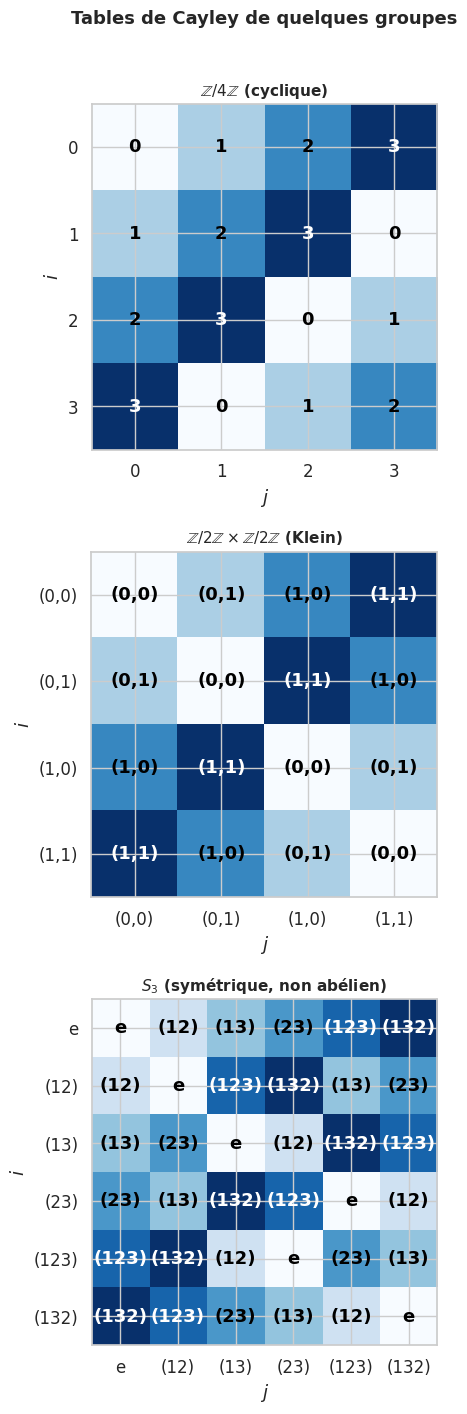
\((S_n, \circ)\) : groupe symétrique des permutations de \(\{1, \ldots, n\}\), d’ordre \(n!\) (non abélien pour \(n \geq 3\)).
Sous-groupe#
Définition 29 (Sous-groupe)
\(H \subseteq G\) est un sous-groupe de \((G, \star)\) si \((H, \star)\) est lui-même un groupe.
Proposition 22 (Critère du sous-groupe)
\(H \neq \varnothing\) est un sous-groupe de \(G\) si et seulement si
Proof. \((\implies)\) Si \(H\) est un sous-groupe, \(x, y \in H \implies y^{-1} \in H \implies x \star y^{-1} \in H\).
\((\impliedby)\) Soit \(a \in H\). Alors \(e = a \star a^{-1} \in H\) (neutralité). Pour \(x \in H\) : \(x^{-1} = e \star x^{-1} \in H\). Pour \(x, y \in H\) : \(x \star y = x \star (y^{-1})^{-1} \in H\) (stabilité). L’associativité est héritée.
Exemple 13
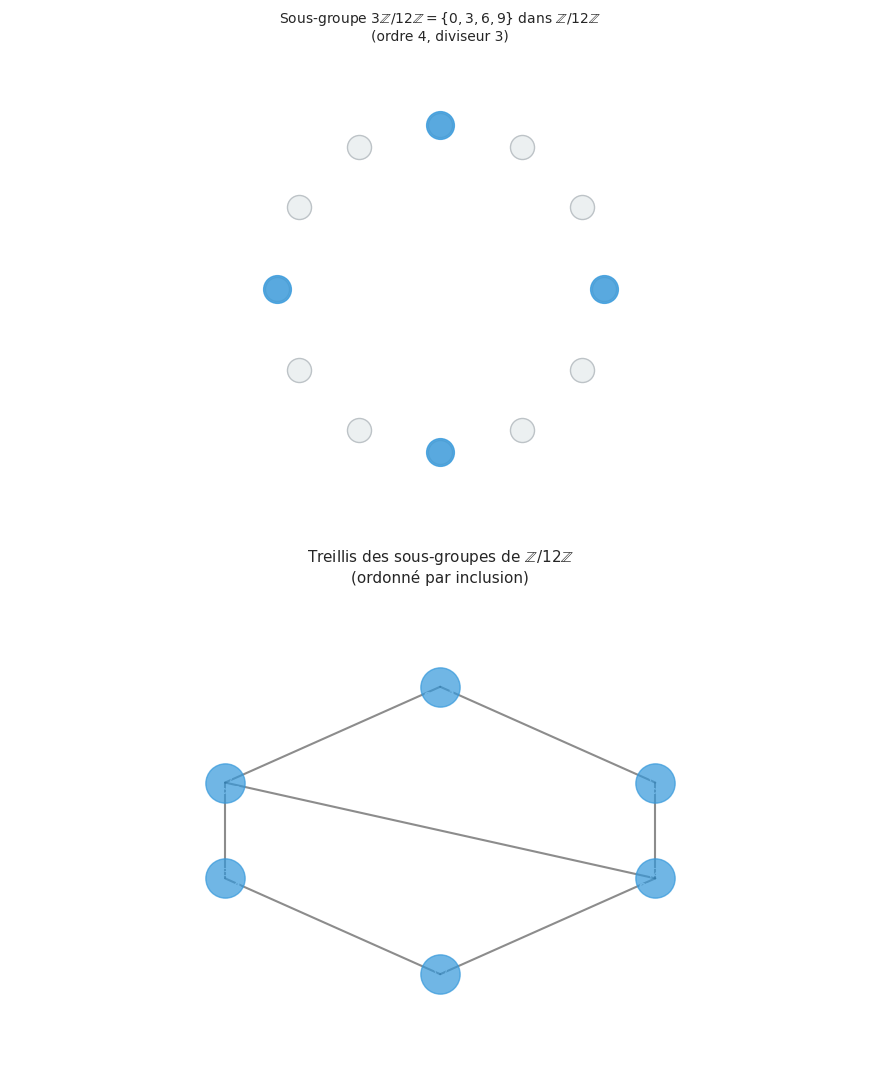
\(n\mathbb{Z} = \{nk \mid k \in \mathbb{Z}\}\) est un sous-groupe de \((\mathbb{Z}, +)\).
\(\{e, r, r^2\} \subset S_3\) où \(r = (123)\) est un sous-groupe cyclique d’ordre 3.
Sous-groupes de \((\mathbb{Z}, +)\)#
Proposition 23
Tout sous-groupe de \((\mathbb{Z}, +)\) est de la forme \(n\mathbb{Z}\) pour un unique \(n \in \mathbb{N}\).
Proof. Soit \(H\) un sous-groupe de \(\mathbb{Z}\). Si \(H = \{0\}\), \(H = 0\mathbb{Z}\). Sinon, \(H\) contient des éléments strictement positifs (car \(x \in H \implies -x \in H\)). Soit \(n = \min(H \cap \mathbb{N}^*)\).
Pour tout \(h \in H\), écrivons \(h = qn + r\) avec \(0 \leq r < n\). Comme \(h \in H\) et \(qn \in H\) (car \(n \in H\) et \(H\) stable), \(r = h - qn \in H\). Par minimalité de \(n\), \(r = 0\), donc \(h \in n\mathbb{Z}\).
Morphismes de groupes#
Définition 30 (Morphisme de groupes)
Un morphisme (ou homomorphisme) de groupes est une application \(f : (G, \star) \to (H, \cdot)\) telle que
Proposition 24 (Propriétés d’un morphisme)
\(f(e_G) = e_H\)
\(f(x^{-1}) = f(x)^{-1}\)
L”image \(f(G)\) est un sous-groupe de \(H\)
Le noyau \(\ker(f) = \{x \in G \mid f(x) = e_H\}\) est un sous-groupe de \(G\)
\(f\) est injective \(\iff \ker(f) = \{e_G\}\)
Proof. \(f(e_G) = f(e_G \star e_G) = f(e_G) \cdot f(e_G)\), d’où \(f(e_G) = e_H\) (simplification dans \(H\)).
\(e_H = f(e_G) = f(x \star x^{-1}) = f(x) \cdot f(x^{-1})\), d’où \(f(x^{-1}) = f(x)^{-1}\).
Si \(f\) injective et \(f(x) = e_H\) : \(f(x) = f(e_G)\), donc \(x = e_G\). Réciproquement, si \(\ker(f) = \{e_G\}\) et \(f(x) = f(y)\) : \(f(x \star y^{-1}) = e_H\), donc \(x \star y^{-1} = e_G\), d’où \(x = y\).
Groupe quotient et théorème d’isomorphisme#
Définition 31 (Sous-groupe distingué)
\(N\) est un sous-groupe distingué (ou normal) de \(G\), noté \(N \trianglelefteq G\), si
Remarque 14
Tout sous-groupe d’un groupe abélien est distingué. Le noyau d’un morphisme est toujours distingué.
Définition 32 (Groupe quotient)
Si \(N \trianglelefteq G\), l’ensemble des classes à gauche \(G/N = \{gN \mid g \in G\}\) est un groupe pour la loi
appelé groupe quotient.
Proposition 25 (Premier théorème d’isomorphisme)
Soit \(f : G \to H\) un morphisme de groupes. Alors
(isomorphisme canonique donné par \(g \ker(f) \mapsto f(g)\)).
Proof. Notons \(K = \ker(f)\). L’application \(\varphi : G/K \to f(G)\), \(gK \mapsto f(g)\) est bien définie (si \(gK = g'K\), alors \(g^{-1}g' \in K\), soit \(f(g^{-1}g') = e_H\), d’où \(f(g) = f(g')\)).
\(\varphi\) est un morphisme : \(\varphi(gK \cdot g'K) = \varphi((gg')K) = f(gg') = f(g)f(g') = \varphi(gK)\varphi(g'K)\).
\(\varphi\) injective : \(\varphi(gK) = e_H \implies f(g) = e_H \implies g \in K \implies gK = K = e_{G/K}\).
\(\varphi\) surjective : pour tout \(f(g) \in f(G)\), \(\varphi(gK) = f(g)\).
Exemple 14
Le morphisme \(f : \mathbb{Z} \to \mathbb{Z}/n\mathbb{Z}\), \(k \mapsto \bar{k}\) a pour noyau \(n\mathbb{Z}\). Le premier théorème donne \(\mathbb{Z}/n\mathbb{Z} \cong \mathbb{Z}/n\mathbb{Z}\) (trivial ici), mais la structure du groupe quotient est celle de \(\mathbb{Z}/n\mathbb{Z}\).
Plus intéressant : le morphisme \(\exp : (\mathbb{R}, +) \to (\mathbb{R}^{+*}, \cdot)\) est surjectif de noyau \(\{0\}\), donc \(\mathbb{R} \cong \mathbb{R}^{+*}\).
Anneau#
Définition 33 (Anneau)
\((A, +, \cdot)\) est un anneau si :
\((A, +)\) est un groupe abélien (neutre \(0_A\))
\((A, \cdot)\) est un monoïde (neutre \(1_A\), associatif)
La multiplication est distributive par rapport à l’addition
Un anneau est commutatif si \(\cdot\) est commutative. Un anneau intègre est un anneau commutatif sans diviseur de zéro.
Proposition 26 (Propriétés immédiates)
Dans tout anneau \((A, +, \cdot)\) :
\(a \cdot 0_A = 0_A \cdot a = 0_A\)
\((-a) \cdot b = a \cdot (-b) = -(a \cdot b)\)
\((-a)(-b) = ab\)
Proof. \(a \cdot 0_A = a \cdot (0_A + 0_A) = a \cdot 0_A + a \cdot 0_A\). Par régularité additive : \(a \cdot 0_A = 0_A\).
\(a \cdot b + a \cdot (-b) = a \cdot (b + (-b)) = a \cdot 0_A = 0_A\), donc \(a \cdot (-b) = -(ab)\).
\((-a)(-b) = -(a \cdot (-b)) = -(-(ab)) = ab\).
Sous-anneau et idéal#
Définition 34 (Idéal)
Un idéal à gauche de \(A\) est un sous-groupe \((I, +)\) de \((A, +)\) tel que \(\forall a \in A, \forall x \in I, ax \in I\). Un idéal bilatère (souvent appelé juste idéal) satisfait de plus \(xa \in I\).
Exemple 15
Dans \(\mathbb{Z}\), tout idéal est de la forme \(n\mathbb{Z}\). Dans \(\mathcal{M}_n(\mathbb{R})\), les matrices à trace nulle forment un sous-espace vectoriel mais pas un idéal.
Définition 35 (Anneau quotient)
Si \(I\) est un idéal bilatère de \(A\), le groupe quotient \(A/I\) est un anneau pour la multiplication \((a + I)(b + I) = ab + I\).
Exemple 16
\(\mathbb{Z}/n\mathbb{Z}\) est l’anneau quotient de \(\mathbb{Z}\) par l’idéal \(n\mathbb{Z}\). C’est un corps si et seulement si \(n\) est premier.
Morphisme d’anneaux#
Définition 36 (Morphisme d’anneaux)
\(f : A \to B\) est un morphisme d’anneaux si \(f(a + b) = f(a) + f(b)\), \(f(ab) = f(a)f(b)\) et \(f(1_A) = 1_B\).
Proposition 27 (Premier théorème d’isomorphisme pour les anneaux)
Si \(f : A \to B\) est un morphisme d’anneaux, \(A/\ker(f) \cong f(A)\).
Corps#
Définition 37 (Corps)
\((K, +, \cdot)\) est un corps si c’est un anneau et si \((K \setminus \{0\}, \cdot)\) est un groupe (tout élément non nul est inversible).
Un corps est commutatif si la multiplication est commutative (en France, « corps » désigne souvent un corps commutatif).
Exemple 17
\(\mathbb{Q}\), \(\mathbb{R}\), \(\mathbb{C}\) : corps commutatifs.
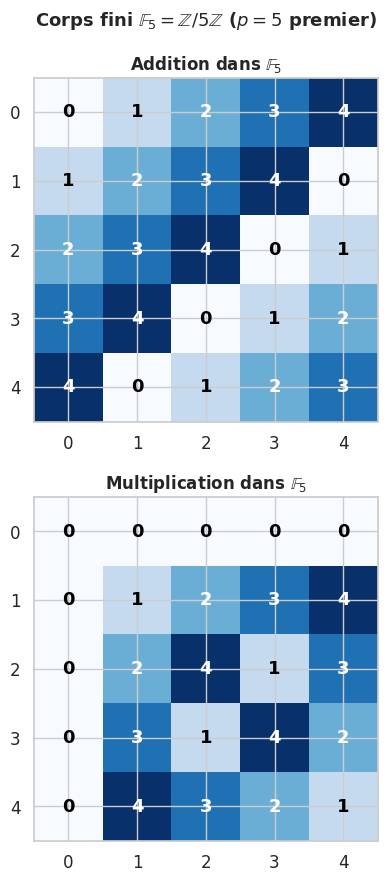
\(\mathbb{Z}/p\mathbb{Z}\) pour \(p\) premier : corps fini à \(p\) éléments (noté \(\mathbb{F}_p\)).
\(\mathbb{H}\) (quaternions) : corps non commutatif.
\(\mathbb{Z}\) : anneau mais pas corps (\(2\) non inversible).
Proposition 28 (Corps finis)
Pour tout premier \(p\) et tout \(n \geq 1\), il existe un unique corps (à isomorphisme près) à \(p^n\) éléments, noté \(\mathbb{F}_{p^n}\) ou \(GF(p^n)\).
Remarque 15
Il n’existe pas de corps fini d’ordre \(n\) si \(n\) n’est pas une puissance d’un nombre premier. Par exemple, il n’existe pas de corps à 6 éléments.
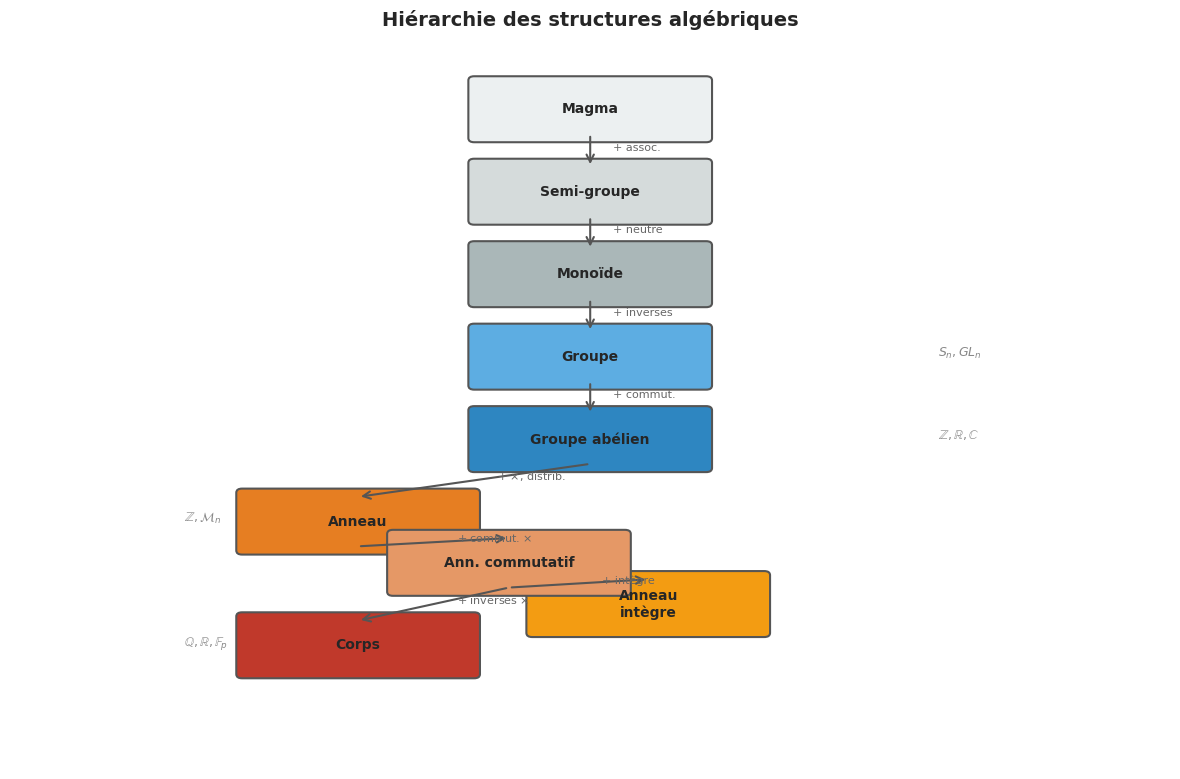
Résumé de la hiérarchie#
Remarque 16
Structure |
Opération(s) |
Propriétés clés |
|---|---|---|
Magma |
\(\star\) |
Stabilité |
Semi-groupe |
\(\star\) |
+ Associativité |
Monoïde |
\(\star\) |
+ Neutre |
Groupe |
\(\star\) |
+ Inverses |
Groupe abélien |
\(\star\) |
+ Commutativité |
Anneau |
\(+\), \(\cdot\) |
Groupe ab. + Monoïde + Distrib. |
Anneau intègre |
\(+\), \(\cdot\) |
+ Pas de div. de zéro |
Corps |
\(+\), \(\cdot\) |
+ Inverses multiplicatifs |