Théorie des groupes#
La notion de groupe est l’une des plus fécondes de toute la mathématique ; elle s’impose partout où il y a symétrie.
Évariste Galois
Introduction#
Nous avons rencontré les groupes comme première structure algébrique. Ce chapitre approfondit la théorie : sous-groupes distingués, groupes quotients, théorèmes d’isomorphisme, actions de groupe, et théorèmes de Sylow. La théorie des groupes est née de l’étude des symétries — symétries géométriques, permutations, transformations — et reste au cœur de l’algèbre moderne et de la physique.
Rappels et définitions#
Définition 239 (Groupe)
Un groupe \((G, \cdot)\) est un ensemble \(G\) muni d’une loi de composition interne \(\cdot\) qui est :
associative : \((ab)c = a(bc)\)
possède un neutre : \(\exists e, \; \forall g, \; eg = ge = g\)
tout élément a un inverse : \(\forall g, \; \exists g^{-1}, \; gg^{-1} = g^{-1}g = e\)
Le groupe est abélien si \(ab = ba\) pour tous \(a, b \in G\). L”ordre du groupe est \(|G|\). L”ordre d’un élément \(g\) est le plus petit \(n \geq 1\) tel que \(g^n = e\) (ou \(+\infty\)).
Exemple 131
\((\mathbb{Z}, +)\), \((\mathbb{Q}^*, \times)\), \((\mathbb{R}^*, \times)\) : groupes abéliens
\((GL_n(\mathbb{R}), \times)\) : groupe non abélien pour \(n \geq 2\)
\((\mathfrak{S}_n, \circ)\) : groupe symétrique, d’ordre \(n!\)
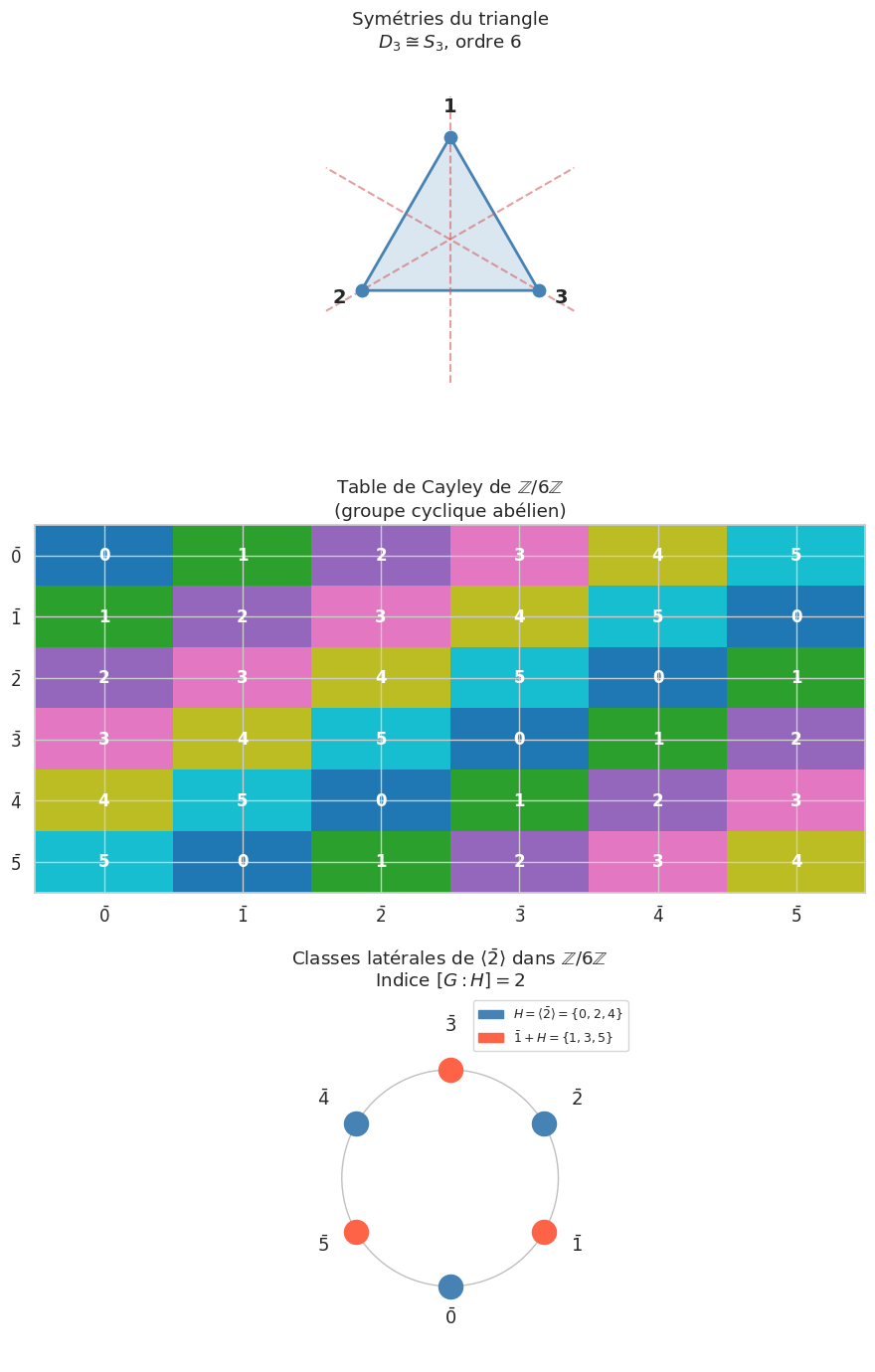
\((\mathbb{Z}/n\mathbb{Z}, +)\) : groupe cyclique d’ordre \(n\)
\((O_n(\mathbb{R}), \times)\), \((SO_n(\mathbb{R}), \times)\) : groupes orthogonaux
Sous-groupes#
Définition 240 (Sous-groupe)
Un sous-ensemble \(H \subset G\) est un sous-groupe de \(G\), noté \(H \leq G\), si \((H, \cdot)\) est lui-même un groupe pour la loi induite.
Proposition 310 (Caractérisation)
\(H \subset G\) est un sous-groupe si et seulement si :
\(H \neq \varnothing\)
\(\forall a, b \in H, \; ab^{-1} \in H\)
Proof. \((\Rightarrow)\) Immédiat par définition.
\((\Leftarrow)\) \(H \neq \varnothing\) : soit \(a \in H\). Alors \(e = aa^{-1} \in H\) (prendre \(b = a\)). Inverse : \(a^{-1} = ea^{-1} \in H\) (prendre \(b = a\)). Stabilité : \(ab = a(b^{-1})^{-1} \in H\). L’associativité est héritée de \(G\).
Exemple 132
\(n\mathbb{Z} = \{nk : k \in \mathbb{Z}\}\) est un sous-groupe de \((\mathbb{Z}, +)\)
\(SL_n(\mathbb{R}) = \{A \in GL_n(\mathbb{R}) : \det(A) = 1\}\) est un sous-groupe de \(GL_n(\mathbb{R})\)
\(\mathfrak{A}_n\) (permutations paires) est un sous-groupe de \(\mathfrak{S}_n\), d’indice 2
Proposition 311 (Intersection de sous-groupes)
L’intersection d’une famille quelconque de sous-groupes est un sous-groupe.
Proof. Soit \((H_i)_{i \in I}\) des sous-groupes et \(H = \bigcap H_i\). Alors \(e \in H_i\) pour tout \(i\), donc \(e \in H\). Si \(a, b \in H\), alors \(a, b \in H_i\) pour tout \(i\), donc \(ab^{-1} \in H_i\) pour tout \(i\), d’où \(ab^{-1} \in H\).
Définition 241 (Sous-groupe engendré et groupe cyclique)
Le sous-groupe engendré par \(S \subset G\) est \(\langle S \rangle = \bigcap\{H \leq G : S \subset H\}\), le plus petit sous-groupe contenant \(S\).
Un groupe est cyclique s’il est engendré par un seul élément : \(G = \langle g \rangle = \{g^n : n \in \mathbb{Z}\}\).
Tout groupe cyclique est isomorphe à \(\mathbb{Z}\) (si infini) ou à \(\mathbb{Z}/n\mathbb{Z}\) (si d’ordre \(n\)).
Morphismes de groupes#
Définition 242 (Morphisme)
Un morphisme de groupes \(\varphi : G \to H\) est une application vérifiant
Proposition 312 (Propriétés immédiates)
Si \(\varphi : G \to H\) est un morphisme : \(\varphi(e_G) = e_H\), \(\varphi(g^{-1}) = \varphi(g)^{-1}\), \(\varphi(g^n) = \varphi(g)^n\).
Proof. \(\varphi(e) = \varphi(ee) = \varphi(e)\varphi(e)\), d’où \(\varphi(e) = e_H\) par simplification. \(e_H = \varphi(gg^{-1}) = \varphi(g)\varphi(g^{-1})\), d’où \(\varphi(g^{-1}) = \varphi(g)^{-1}\).
Définition 243 (Noyau, image, types)
Noyau : \(\ker(\varphi) = \{g \in G : \varphi(g) = e_H\} \leq G\)
Image : \(\mathrm{Im}(\varphi) = \varphi(G) \leq H\)
Isomorphisme : morphisme bijectif (\(G \cong H\))
Automorphisme : isomorphisme \(G \to G\)
\(\varphi\) est injective \(\iff\) \(\ker(\varphi) = \{e\}\).
Proof. \(\ker\varphi \leq G\) : \(e \in \ker\varphi\). Si \(a, b \in \ker\varphi\) : \(\varphi(ab^{-1}) = \varphi(a)\varphi(b)^{-1} = e \cdot e = e\).
Injectivité : \((\Rightarrow)\) Si \(\varphi(g) = e\), par injectivité \(g = e\). \((\Leftarrow)\) Si \(\varphi(a) = \varphi(b)\), alors \(\varphi(ab^{-1}) = e\), donc \(ab^{-1} = e\), i.e. \(a = b\).
Théorème de Lagrange#
Définition 244 (Classes latérales et indice)
Soit \(H \leq G\) et \(g \in G\). La classe à gauche de \(g\) modulo \(H\) est \(gH = \{gh : h \in H\}\).
Les classes à gauche forment une partition de \(G\) : deux classes sont égales ou disjointes, et \(|aH| = |H|\).
L”indice de \(H\) dans \(G\) est le nombre de classes : \([G : H] = |G/H|\).
Proof. La relation \(a \sim b \iff a^{-1}b \in H\) est une relation d’équivalence (réflexivité : \(a^{-1}a = e \in H\) ; symétrie ; transitivité). Les classes d’équivalence sont les \(aH\). \(|aH| = |H|\) car \(h \mapsto ah\) est une bijection de \(H\) sur \(aH\).
Théorème 47 (Théorème de Lagrange)
Si \(G\) est un groupe fini et \(H \leq G\), alors
En particulier, l’ordre de \(H\) divise l’ordre de \(G\).
Proof. Les classes à gauche partitionnent \(G\) en \([G:H]\) ensembles disjoints de cardinal \(|H|\).
Corollaire 1
L’ordre de tout élément \(g\) divise \(|G|\)
Si \(|G|\) est premier, \(G\) est cyclique
\(g^{|G|} = e\) pour tout \(g \in G\) (petit théorème de Fermat généralisé)
Proof. Ordre d’un élément : L’ordre de \(g\) est \(|\langle g \rangle|\), sous-groupe de \(G\), donc divise \(|G|\).
\(|G| = p\) premier : Tout \(g \neq e\) a un ordre \(d | p\) avec \(d > 1\), donc \(d = p\) et \(G = \langle g \rangle\).
\(g^{|G|} = e\) : L’ordre de \(g\) divise \(|G|\), donc \(g^{|G|} = (g^{\mathrm{ord}(g)})^{|G|/\mathrm{ord}(g)} = e^{|G|/\mathrm{ord}(g)} = e\).
Sous-groupes distingués et groupes quotients#
Définition 245 (Sous-groupe distingué)
\(H \leq G\) est distingué (ou normal), noté \(H \trianglelefteq G\), si
c’est-à-dire \(gH = Hg\) pour tout \(g\) (les classes gauches et droites coïncident).
Remarque 127
Tout sous-groupe d’un groupe abélien est distingué.
Le noyau d’un morphisme est toujours distingué.
\(H \trianglelefteq G \iff H\) est le noyau d’un morphisme.
Définition 246 (Groupe quotient)
Si \(H \trianglelefteq G\), l’ensemble des classes \(G/H = \{gH : g \in G\}\) est muni de la loi
qui en fait un groupe, le groupe quotient.
Proof. Bonne définition : si \(aH = a'H\) et \(bH = b'H\), alors \(a' = ah_1\), \(b' = bh_2\) avec \(h_1, h_2 \in H\). Comme \(H\) est distingué, \(h_1 b = bh_3\) pour un certain \(h_3 \in H\), donc \(a'b' = ah_1 bh_2 = abh_3 h_2\), et \((a'b')H = (ab)H\).
Théorème 48 (Premier théorème d’isomorphisme)
Soit \(\varphi : G \to H\) un morphisme de groupes. Alors
L’isomorphisme est \(\bar{\varphi} : g\ker\varphi \mapsto \varphi(g)\).
Proof. Bonne définition : \(g\ker\varphi = g'\ker\varphi \implies g^{-1}g' \in \ker\varphi \implies \varphi(g) = \varphi(g')\).
Morphisme : \(\bar{\varphi}(gK \cdot g'K) = \varphi(gg') = \varphi(g)\varphi(g')\).
Injectivité : \(\bar{\varphi}(gK) = e_H \implies g \in K \implies gK = K = e_{G/K}\).
Surjectivité : Sur \(\mathrm{Im}(\varphi)\) par définition.
Exemple 133
\(\varphi : \mathbb{Z} \to \mathbb{Z}/n\mathbb{Z}\), \(k \mapsto \bar{k}\) : \(\ker\varphi = n\mathbb{Z}\), donc \(\mathbb{Z}/n\mathbb{Z} \cong \mathbb{Z}/n\mathbb{Z}\) ✓
\(\det : GL_n(\mathbb{R}) \to \mathbb{R}^*\) : \(\ker(\det) = SL_n(\mathbb{R})\), donc \(GL_n(\mathbb{R})/SL_n(\mathbb{R}) \cong \mathbb{R}^*\)
\(\mathrm{sgn} : \mathfrak{S}_n \to \{-1, 1\}\) : \(\ker(\mathrm{sgn}) = \mathfrak{A}_n\), donc \(\mathfrak{S}_n/\mathfrak{A}_n \cong \mathbb{Z}/2\mathbb{Z}\)
Actions de groupe#
Définition 247 (Action de groupe)
Une action d’un groupe \(G\) sur un ensemble \(X\) est une application \(G \times X \to X\), \((g, x) \mapsto g \cdot x\), vérifiant :
\(e \cdot x = x\) pour tout \(x\)
\((gh) \cdot x = g \cdot (h \cdot x)\) pour tous \(g, h, x\)
Exemple 134
\(G\) agit sur lui-même par translation à gauche : \(g \cdot x = gx\)
\(G\) agit sur lui-même par conjugaison : \(g \cdot x = gxg^{-1}\)
\(GL_n(\mathbb{R})\) agit sur \(\mathbb{R}^n\) par multiplication matricielle
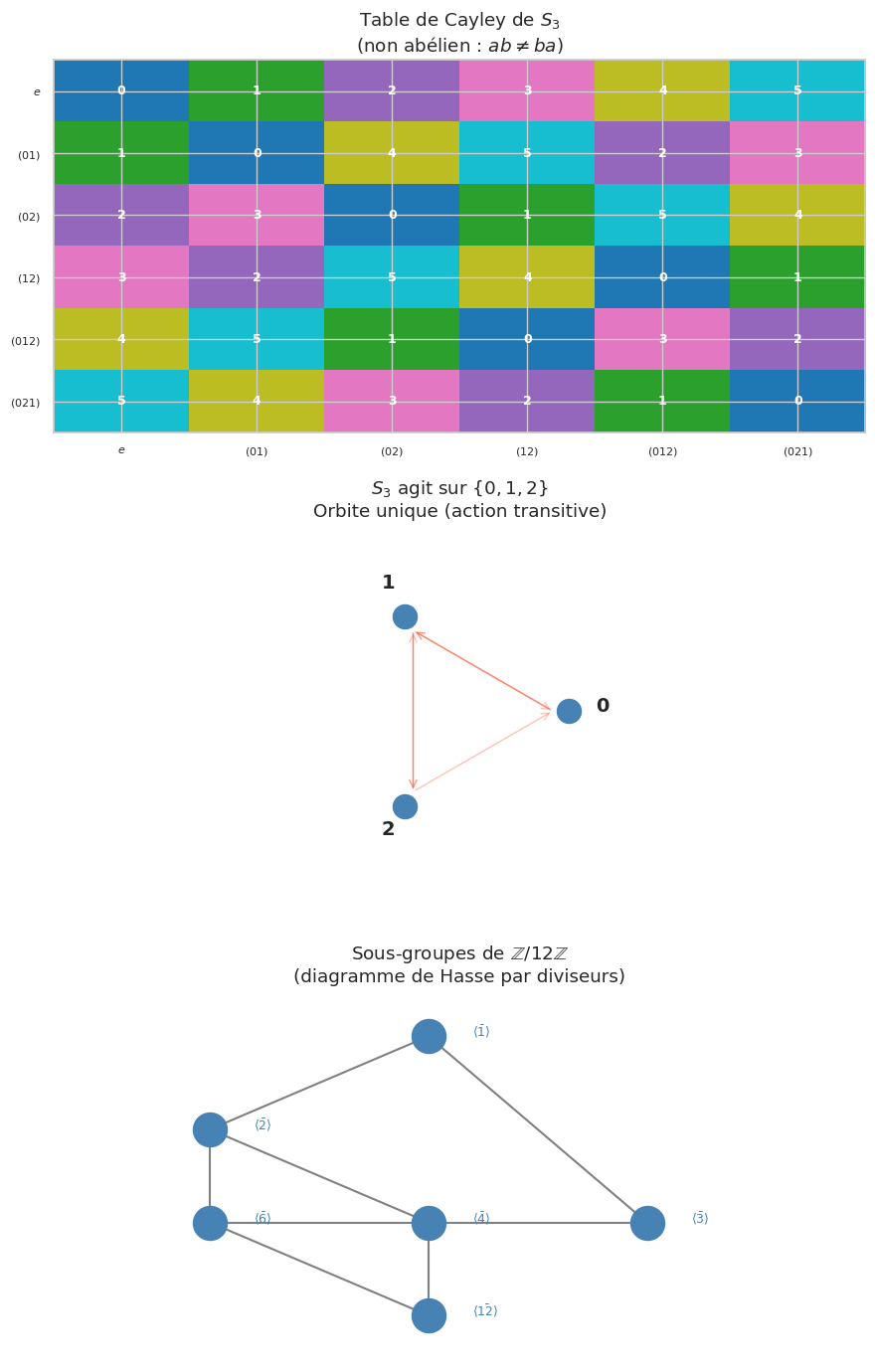
\(\mathfrak{S}_n\) agit sur \(\{1, \ldots, n\}\) par \(\sigma \cdot i = \sigma(i)\)
Définition 248 (Orbite et stabilisateur)
Soit \(G\) agissant sur \(X\) et \(x \in X\).
L”orbite : \(\mathrm{Orb}(x) = G \cdot x = \{g \cdot x : g \in G\}\)
Le stabilisateur : \(G_x = \{g \in G : g \cdot x = x\} \leq G\)
Théorème 49 (Formule orbite-stabilisateur)
Si \(G\) est fini :
Proof. L’application \(g G_x \mapsto g \cdot x\) est une bijection bien définie de \(G/G_x\) sur \(\mathrm{Orb}(x)\).
Bonne définition : \(gG_x = g'G_x \implies g^{-1}g' \in G_x \implies g \cdot x = g' \cdot x\). Injective : \(g \cdot x = g' \cdot x \implies g^{-1}g' \in G_x\). Surjective : par définition de l’orbite.
Théorème 50 (Équation aux classes)
Les orbites partitionnent \(X\). Pour \(G\) agissant par conjugaison sur lui-même (orbites = classes de conjugaison) :
où \(Z(G) = \{g : \forall h, gh = hg\}\) est le centre, \(C_G(x)\) le centralisateur, et la somme porte sur un représentant par classe non centrale.
Groupes symétriques#
Définition 249 (Cycle, transposition, signature)
Un cycle \((a_1 \; a_2 \; \cdots \; a_k)\) envoie \(a_i \mapsto a_{i+1}\) (modulo \(k\)) et fixe le reste. Une transposition est un cycle de longueur 2.
Toute permutation se décompose de manière unique (à l’ordre des facteurs) en produit de cycles à supports disjoints.
Il existe un unique morphisme \(\varepsilon : \mathfrak{S}_n \to \{-1, 1\}\) tel que \(\varepsilon(\tau) = -1\) pour toute transposition : la signature.
Définition 250 (Groupe alterné)
\(\mathfrak{A}_n = \ker(\varepsilon)\) est le sous-groupe des permutations paires, d’ordre \(n!/2\) et d’indice 2 dans \(\mathfrak{S}_n\).
\(\mathfrak{A}_n\) est simple (pas de sous-groupe distingué non trivial) pour \(n \geq 5\).
Remarque 128
La simplicité de \(\mathfrak{A}_5\) est la clé de la preuve (Abel-Galois) de l’impossibilité de résoudre par radicaux les équations de degré \(\geq 5\).
Produit direct et théorème chinois#
Définition 251 (Produit direct)
Le produit direct \(G_1 \times G_2\) est l’ensemble des couples \((g_1, g_2)\) muni de \((g_1, g_2)(h_1, h_2) = (g_1 h_1, g_2 h_2)\).
Théorème 51 (Théorème chinois pour les groupes)
Si \(\gcd(m, n) = 1\), alors \(\mathbb{Z}/mn\mathbb{Z} \cong \mathbb{Z}/m\mathbb{Z} \times \mathbb{Z}/n\mathbb{Z}\).
Proof. Le morphisme \(\varphi : \mathbb{Z} \to \mathbb{Z}/m\mathbb{Z} \times \mathbb{Z}/n\mathbb{Z}\), \(k \mapsto (\bar{k}, \bar{k})\) a pour noyau \(mn\mathbb{Z}\) (car \(m | k\) et \(n | k \iff mn | k\) si \(\gcd(m,n) = 1\)). Les deux groupes ont le même cardinal \(mn\), donc \(\varphi\) est surjectif.
Théorèmes de Sylow#
Théorème 52 (Théorèmes de Sylow)
Soit \(G\) un groupe fini d’ordre \(n = p^a m\) avec \(p\) premier et \(\gcd(p, m) = 1\).
\(G\) possède au moins un \(p\)-sous-groupe de Sylow (sous-groupe d’ordre \(p^a\)).
Tous les \(p\)-Sylow sont conjugués entre eux.
Le nombre \(n_p\) de \(p\)-Sylow vérifie \(n_p \equiv 1 \pmod{p}\) et \(n_p \mid m\).
Remarque 129
Les théorèmes de Sylow sont parmi les outils les plus puissants pour classifier les groupes finis. Ils permettent souvent de prouver qu’un groupe d’ordre donné n’est pas simple.
Exemple 135
Tout groupe d’ordre 15 est cyclique. \(|G| = 15 = 3 \times 5\).
\(n_3 \mid 5\) et \(n_3 \equiv 1 \pmod 3\) : \(n_3 \in \{1, 5\}\), mais \(5 \not\equiv 1 \pmod 3\). Donc \(n_3 = 1\) : unique 3-Sylow \(H_3 \trianglelefteq G\).
\(n_5 \mid 3\) et \(n_5 \equiv 1 \pmod 5\) : \(n_5 = 1\). Unique 5-Sylow \(H_5 \trianglelefteq G\).
\(H_3 \cap H_5 = \{e\}\) (ordres premiers entre eux) et \(|H_3 H_5| = 15 = |G|\). Donc \(G = H_3 \times H_5 \cong \mathbb{Z}/3\mathbb{Z} \times \mathbb{Z}/5\mathbb{Z} \cong \mathbb{Z}/15\mathbb{Z}\).
Résumé#
Concept |
Propriété clé |
|---|---|
Lagrange |
$ |
Sous-groupe distingué |
\(gHg^{-1} = H \iff \ker\) d’un morphisme |
Quotient \(G/H\) |
Groupe si \(H \trianglelefteq G\) |
1er th. d’isomorphisme |
\(G/\ker\varphi \cong \mathrm{Im}(\varphi)\) |
Orbite-stabilisateur |
$ |
\(\mathfrak{A}_n\) simple |
pour \(n \geq 5\) (clé de Galois) |
Sylow |
Existence, conjugaison, \(n_p \equiv 1 \pmod p\), \(n_p \mid m\) |
\(\gcd(m,n)=1\) |
\(\mathbb{Z}/mn\mathbb{Z} \cong \mathbb{Z}/m\mathbb{Z} \times \mathbb{Z}/n\mathbb{Z}\) |