Fonctions usuelles#

La lecture d’Euler est le maître de nous tous.

Pierre-Simon de Laplace

Ce chapitre rassemble les fonctions fondamentales de l’analyse : puissances, exponentielle, logarithme, fonctions trigonométriques et hyperboliques, ainsi que leurs réciproques. Ces fonctions sont les briques élémentaires à partir desquelles se construit l’essentiel de l’analyse réelle et complexe.

Hide code cell source

import numpy as np
import matplotlib.pyplot as plt
import matplotlib.patches as patches
from matplotlib.patches import FancyArrowPatch
import seaborn as sns

sns.set_theme(style="whitegrid", palette="muted", font_scale=1.1)

Fonctions puissances#

Puissances entières#

Définition 108 (Puissance entière)

Pour \(n \in \mathbb{Z}\) et \(x \in \mathbb{R}\) (avec \(x \neq 0\) si \(n < 0\)) :

\[x^n = \underbrace{x \cdot x \cdots x}_{n \text{ fois}} \quad (n \geq 0), \qquad x^n = \frac{1}{x^{-n}} \quad (n < 0).\]

Par convention, \(x^0 = 1\) pour tout \(x \neq 0\).

Proposition 159 (Propriétés algébriques)

\(\forall x, y \in \mathbb{R}^*\), \(\forall m, n \in \mathbb{Z}\) :

  • \(x^{m+n} = x^m \cdot x^n\)

  • \(x^{mn} = (x^m)^n\)

  • \((xy)^n = x^n y^n\)

Proposition 160 (Dérivée et classe)

La fonction \(x \mapsto x^n\) est de classe \(\mathcal{C}^\infty\) sur \(\mathbb{R}\) (si \(n \geq 0\)) ou sur \(\mathbb{R}^*\) (si \(n < 0\)), et

\[(x^n)' = nx^{n-1}.\]

Remarque 70

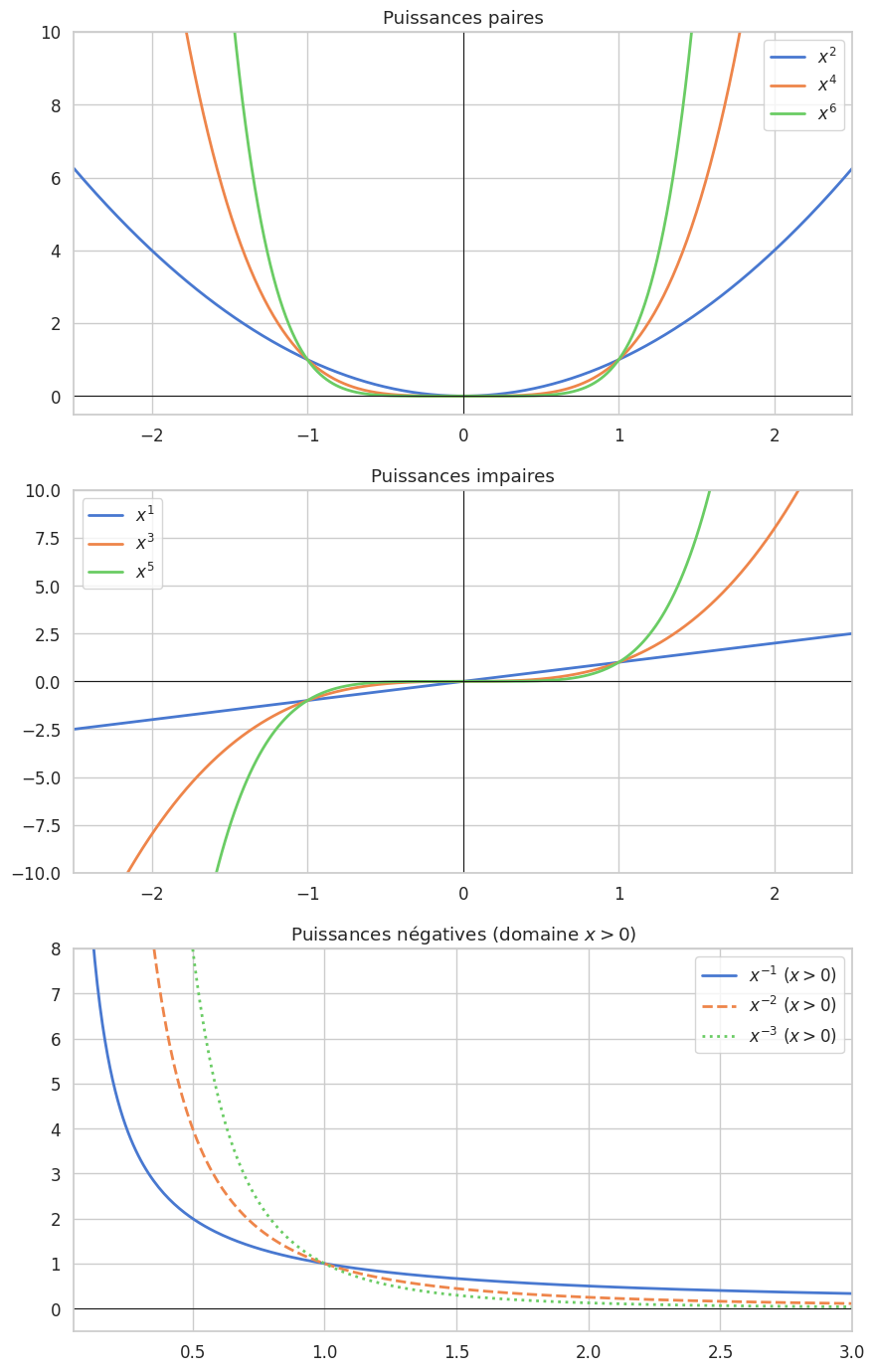
Les monômes \(x \mapsto x^n\) ont des comportements très différents selon la parité de \(n\) et son signe :

  • \(n\) pair : fonction paire, minimum en 0 (si \(n > 0\))

  • \(n\) impair : fonction impaire, strictement croissante sur \(\mathbb{R}\) (si \(n > 0\))

  • \(n < 0\) : pôle en 0, asymptote horizontale \(y = 0\) en \(\pm\infty\)
Hide code cell source

fig, axes = plt.subplots(3, 1, figsize=(9, 14))

x_pos = np.linspace(0.01, 3, 400)
x_all = np.linspace(-2.5, 2.5, 500)
x_neg = np.concatenate([np.linspace(-3, -0.05, 200), np.linspace(0.05, 3, 200)])

# Puissances paires
for n in [2, 4, 6]:
    axes[0].plot(x_all, x_all**n, linewidth=2, label=f'$x^{n}$')
axes[0].set_xlim(-2.5, 2.5)
axes[0].set_ylim(-0.5, 10)
axes[0].set_title('Puissances paires')
axes[0].legend()
axes[0].axhline(0, color='k', lw=0.8)
axes[0].axvline(0, color='k', lw=0.8)

# Puissances impaires
for n in [1, 3, 5]:
    axes[1].plot(x_all, x_all**n, linewidth=2, label=f'$x^{n}$')
axes[1].set_xlim(-2.5, 2.5)
axes[1].set_ylim(-10, 10)
axes[1].set_title('Puissances impaires')
axes[1].legend()
axes[1].axhline(0, color='k', lw=0.8)
axes[1].axvline(0, color='k', lw=0.8)

# Puissances négatives
for n, ls in [(-1, '-'), (-2, '--'), (-3, ':')]:
    axes[2].plot(np.linspace(0.1, 3, 300), np.linspace(0.1, 3, 300)**n,
                 linewidth=2, linestyle=ls, label=f'$x^{{{n}}}$ ($x>0$)')
axes[2].set_xlim(0.05, 3)
axes[2].set_ylim(-0.5, 8)
axes[2].set_title('Puissances négatives (domaine $x>0$)')
axes[2].legend()
axes[2].axhline(0, color='k', lw=0.8)

plt.tight_layout()
plt.show()
_images/d51f931ed1ed89e9e627c7f0e16e71059e131e102ad39742d7560de9d02057c1.png

Puissances réelles#

Définition 109 (Puissance réelle)

Pour \(x > 0\) et \(\alpha \in \mathbb{R}\) :

\[x^\alpha = e^{\alpha \ln x}.\]

Pour \(r = p/q \in \mathbb{Q}\) avec \(q \geq 1\), cela coïncide avec \(x^r = (\sqrt[q]{x})^p\).

Proposition 161

La fonction \(x \mapsto x^\alpha\) est définie sur \(]0, +\infty[\), de classe \(\mathcal{C}^\infty\), et

\[(x^\alpha)' = \alpha x^{\alpha - 1}, \qquad (x^\alpha)'' = \alpha(\alpha-1) x^{\alpha-2}.\]

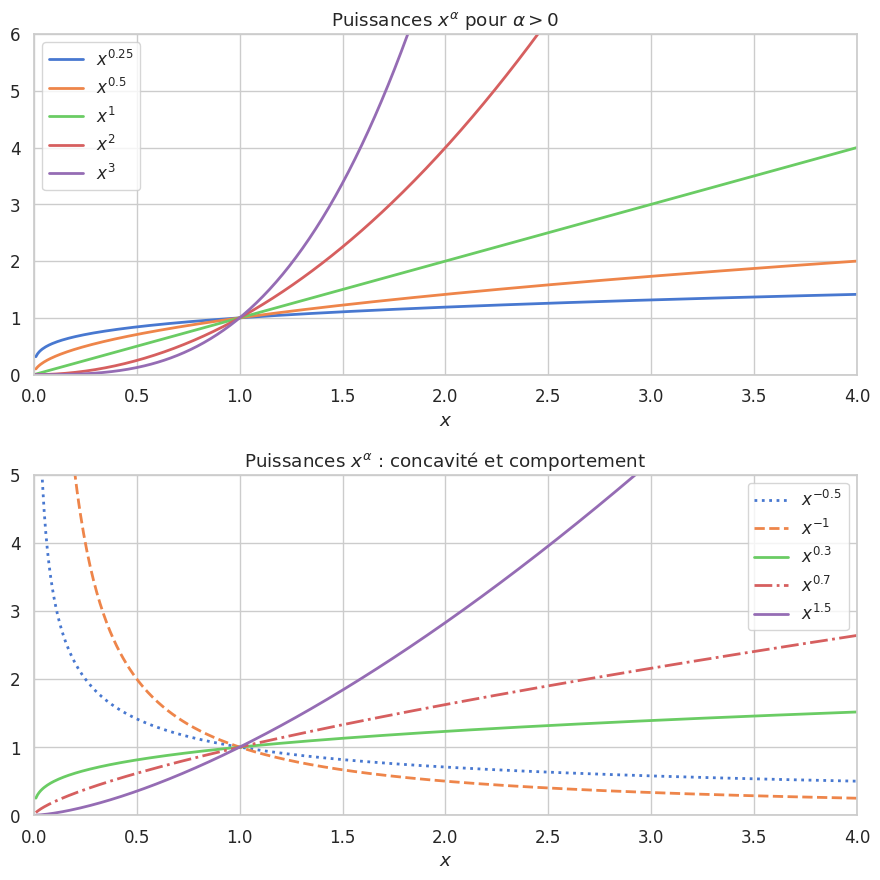
Elle est convexe si \(\alpha \geq 1\) ou \(\alpha \leq 0\), concave si \(0 \leq \alpha \leq 1\).

Remarque 71

Le comportement en 0 et en \(+\infty\) dépend du signe de \(\alpha\) :

  • \(\alpha > 0\) : \(x^\alpha \to 0\) en \(0^+\) et \(x^\alpha \to +\infty\) en \(+\infty\)

  • \(\alpha < 0\) : \(x^\alpha \to +\infty\) en \(0^+\) et \(x^\alpha \to 0\) en \(+\infty\)

  • \(\alpha = 0\) : \(x^0 = 1\) (fonction constante)
Hide code cell source

fig, axes = plt.subplots(2, 1, figsize=(9, 9))

x = np.linspace(0.01, 4, 500)

# Puissances réelles positives
for alpha in [0.25, 0.5, 1, 2, 3]:
    axes[0].plot(x, x**alpha, linewidth=2, label=f'$x^{{{alpha}}}$')
axes[0].set_xlim(0, 4)
axes[0].set_ylim(0, 6)
axes[0].set_title('Puissances $x^\\alpha$ pour $\\alpha > 0$')
axes[0].legend()
axes[0].axhline(0, color='k', lw=0.8)
axes[0].set_xlabel('$x$')

# Puissances avec alpha négatif et entre 0 et 1
for alpha, ls in [(-0.5, ':'), (-1, '--'), (0.3, '-'), (0.7, '-.'), (1.5, '-')]:
    axes[1].plot(x, x**alpha, linewidth=2, linestyle=ls, label=f'$x^{{{alpha}}}$')
axes[1].set_xlim(0, 4)
axes[1].set_ylim(0, 5)
axes[1].set_title('Puissances $x^\\alpha$ : concavité et comportement')
axes[1].legend()
axes[1].axhline(0, color='k', lw=0.8)
axes[1].set_xlabel('$x$')

plt.tight_layout()
plt.show()
_images/596d6f32386688909e5c42c36ac81dfb4539fa8f4a17304ac204d5e25b3b0a6b.png

Exponentielle et logarithme#

Le logarithme népérien#

Définition 110 (Logarithme népérien)

Le logarithme népérien est l’unique primitive de \(x \mapsto 1/x\) sur \(]0, +\infty[\) s’annulant en 1 :

\[\ln : \:]0, +\infty[ \to \mathbb{R}, \qquad \ln'(x) = \frac{1}{x}, \quad \ln(1) = 0.\]

Proposition 162 (Propriétés du logarithme)

\(\forall x, y > 0\), \(\forall \alpha \in \mathbb{R}\) :

  • \(\ln(xy) = \ln x + \ln y\) (morphisme de \((\mathbb{R}^*_+, \cdot)\) dans \((\mathbb{R}, +)\))

  • \(\ln\!\left(\dfrac{x}{y}\right) = \ln x - \ln y\)

  • \(\ln(x^\alpha) = \alpha \ln x\)

  • \(\ln\) est strictement croissante et concave sur \(]0, +\infty[\)

  • \(\lim_{x \to 0^+} \ln x = -\infty\), \(\quad \lim_{x \to +\infty} \ln x = +\infty\)

  • \(\ln\) réalise une bijection de \(]0, +\infty[\) sur \(\mathbb{R}\)

Proof. Morphisme : Posons \(g(x) = \ln(ax)\) pour \(a > 0\) fixé. Alors \(g'(x) = \frac{1}{x} = \ln'(x)\). Donc \(g - \ln\) est constante ; en \(x = 1\) : \(g(1) - \ln(1) = \ln(a)\). Ainsi \(\ln(ax) = \ln(a) + \ln(x)\) pour tout \(x > 0\).

Concavité : \(\ln''(x) = -1/x^2 < 0\).

Bijectivité : \(\ln\) est continue, strictement croissante, et \(\ln(2^n) = n\ln 2 \to +\infty\), \(\ln(2^{-n}) \to -\infty\) : par le TVI, \(\ln\) est surjective.

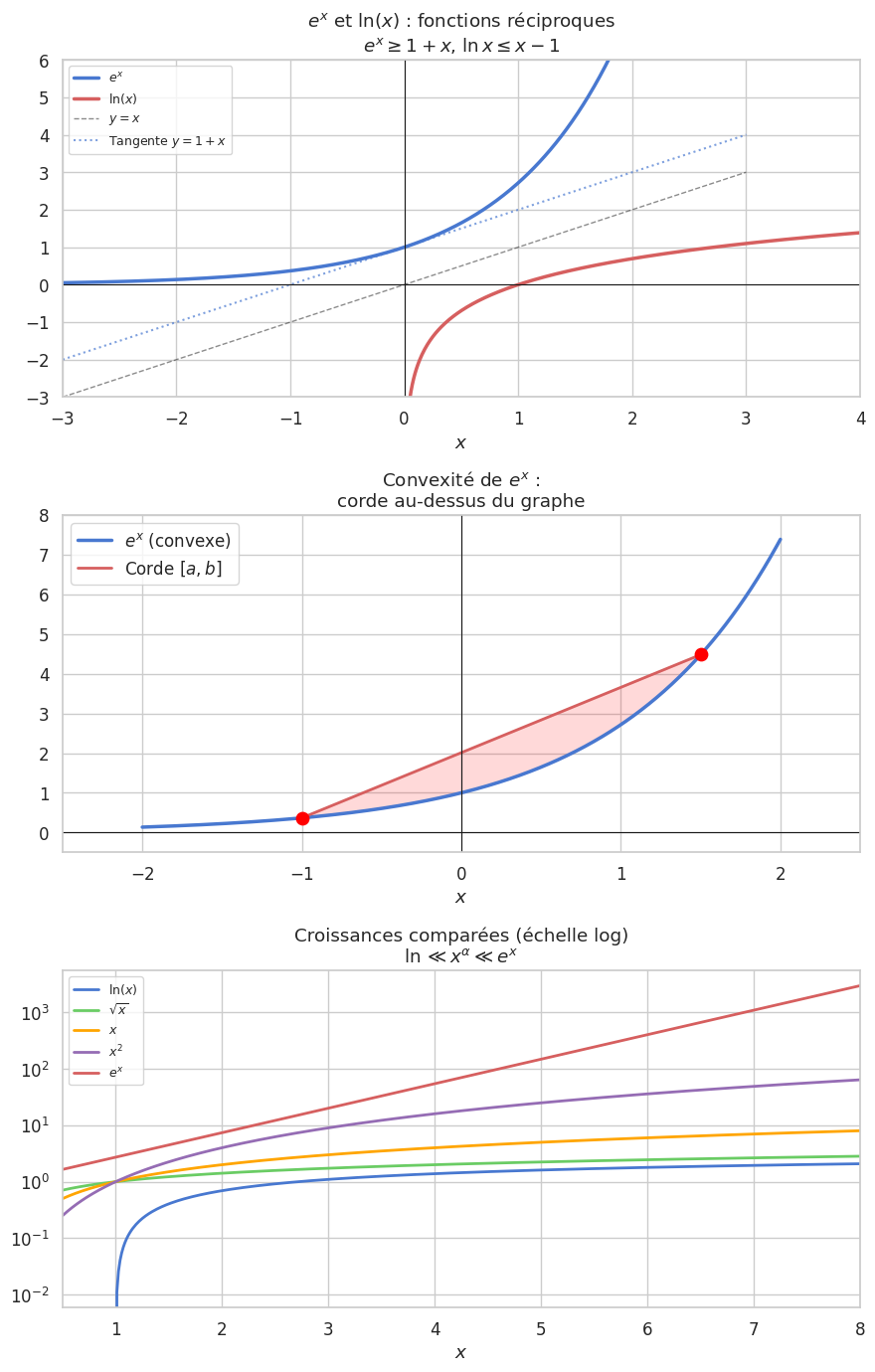
Proposition 163 (Inégalité fondamentale)

\[\forall x > 0, \quad \ln x \leq x - 1,\]

avec égalité si et seulement si \(x = 1\).

Proof. Posons \(\varphi(x) = \ln x - (x - 1)\). On a \(\varphi'(x) = 1/x - 1\), qui s’annule en \(x = 1\) et est positif sur \(]0, 1[\) et négatif sur \(]1, +\infty[\). Donc \(\varphi\) est maximale en \(x = 1\), avec \(\varphi(1) = 0\).

L’exponentielle#

Définition 111 (Exponentielle)

La fonction exponentielle \(\exp : \mathbb{R} \to \:]0, +\infty[\) est la bijection réciproque de \(\ln\).

\[y = e^x \iff x = \ln y.\]

Proposition 164 (Propriétés de l’exponentielle)

\(\forall x, y \in \mathbb{R}\) :

  • \(e^{x+y} = e^x \cdot e^y\) (morphisme de \((\mathbb{R}, +)\) dans \((\mathbb{R}^*_+, \cdot)\))

  • \(e^{-x} = \dfrac{1}{e^x}\), \(\quad e^0 = 1\)

  • \(\exp' = \exp\) : l’exponentielle est sa propre dérivée

  • \(e^x > 0\) pour tout \(x\)

  • \(\exp\) est strictement croissante et convexe sur \(\mathbb{R}\)

  • \(\lim_{x \to -\infty} e^x = 0\), \(\quad \lim_{x \to +\infty} e^x = +\infty\)

Proof. Dérivée : Par dérivation de la réciproque : \(\exp'(x) = \dfrac{1}{\ln'(\exp(x))} = \dfrac{1}{1/e^x} = e^x\).

Convexité : \(\exp'' = \exp > 0\).

Morphisme : \(\ln(e^x \cdot e^y) = x + y = \ln(e^{x+y})\), puis injectivité de \(\ln\).

Proposition 165 (Inégalité de convexité)

\[\forall x \in \mathbb{R}, \quad e^x \geq 1 + x,\]

avec égalité si et seulement si \(x = 0\).

Proof. Cela résulte directement de \(\ln x \leq x - 1\) en posant \(x = e^t\) : \(t \leq e^t - 1\), soit \(e^t \geq 1 + t\). Ou directement : \(\exp\) est convexe, donc son graphe est au-dessus de toute tangente ; la tangente en 0 est \(y = 1 + x\).

Définition 112 (Nombre \(e\))

\[e = \exp(1) = \sum_{n=0}^{+\infty} \frac{1}{n!} \approx 2{,}71828\ldots\]

Proposition 166 (Irrationalité de \(e\))

Le nombre \(e\) est irrationnel (et même transcendant).

Proof. Irrationalité. Par l’absurde : supposons \(e = p/q\) avec \(p, q \in \mathbb{N}^*\). Posons

\[N = q!\left(e - \sum_{k=0}^{q} \frac{1}{k!}\right) = q! \sum_{k=q+1}^{+\infty} \frac{1}{k!}.\]

D’une part, \(N = (q-1)! p - \sum_{k=0}^{q} \frac{q!}{k!} \in \mathbb{Z}\). D’autre part, \(0 < N < \sum_{j=1}^{+\infty} \frac{1}{(q+1)^j} = \frac{1}{q} \leq 1\). Contradiction : il n’existe pas d’entier dans \(]0, 1[\).
Hide code cell source

fig, axes = plt.subplots(3, 1, figsize=(9, 14))

# exp et ln, symétrie par rapport à y=x
x_exp = np.linspace(-3, 3, 500)
x_log = np.linspace(0.01, 6, 500)

axes[0].plot(x_exp, np.exp(x_exp), 'b-', linewidth=2.5, label='$e^x$')
axes[0].plot(x_log, np.log(x_log), 'r-', linewidth=2.5, label='$\\ln(x)$')
axes[0].plot(x_exp, x_exp, 'k--', linewidth=1, alpha=0.5, label='$y=x$')
# Tangente en 0 pour exp : y = 1 + x
axes[0].plot(x_exp, 1 + x_exp, 'b:', linewidth=1.5, alpha=0.7, label='Tangente $y=1+x$')
axes[0].axhline(0, color='k', lw=0.8)
axes[0].axvline(0, color='k', lw=0.8)
axes[0].set_xlim(-3, 4)
axes[0].set_ylim(-3, 6)
axes[0].set_title('$e^x$ et $\\ln(x)$ : fonctions réciproques\n$e^x \\geq 1+x$, $\\ln x \\leq x-1$')
axes[0].legend(fontsize=9)
axes[0].set_xlabel('$x$')

# Convexité de exp : droite reliant deux points est au-dessus du graphe
x = np.linspace(-2, 2, 500)
a, b = -1, 1.5
t = np.linspace(0, 1, 50)
axes[1].plot(x, np.exp(x), 'b-', linewidth=2.5, label='$e^x$ (convexe)')
axes[1].plot([a, b], [np.exp(a), np.exp(b)], 'r-', linewidth=2, label='Corde $[a,b]$')
axes[1].fill_between(np.linspace(a, b, 100),
                      np.exp(np.linspace(a, b, 100)),
                      np.exp(a) + (np.exp(b)-np.exp(a))/(b-a)*(np.linspace(a,b,100)-a),
                      alpha=0.15, color='red')
axes[1].scatter([a, b], [np.exp(a), np.exp(b)], color='red', s=80, zorder=5)
axes[1].axhline(0, color='k', lw=0.8)
axes[1].axvline(0, color='k', lw=0.8)
axes[1].set_xlim(-2.5, 2.5)
axes[1].set_ylim(-0.5, 8)
axes[1].set_title('Convexité de $e^x$ :\ncorde au-dessus du graphe')
axes[1].legend()
axes[1].set_xlabel('$x$')

# Croissances comparées
x = np.linspace(0.5, 8, 500)
axes[2].semilogy(x, np.log(x), 'b-', linewidth=2, label='$\\ln(x)$')
axes[2].semilogy(x, x**0.5, 'g-', linewidth=2, label='$\\sqrt{x}$')
axes[2].semilogy(x, x, 'orange', linewidth=2, label='$x$')
axes[2].semilogy(x, x**2, 'm-', linewidth=2, label='$x^2$')
axes[2].semilogy(x, np.exp(x), 'r-', linewidth=2, label='$e^x$')
axes[2].set_xlim(0.5, 8)
axes[2].set_title('Croissances comparées (échelle log)\n$\\ln \\ll x^\\alpha \\ll e^x$')
axes[2].legend(fontsize=9)
axes[2].set_xlabel('$x$')

plt.tight_layout()
plt.show()
_images/70ad9426fd853de2cd15e8ef9141f20f3071b4f62de34896e4738bd399fba627.png

Croissances comparées#

Proposition 167 (Croissances comparées)

\(\forall \alpha > 0\), \(\forall \beta > 0\) :

\[\lim_{x \to +\infty} \frac{(\ln x)^\alpha}{x^\beta} = 0, \qquad \lim_{x \to +\infty} \frac{x^\alpha}{e^{\beta x}} = 0, \qquad \lim_{x \to 0^+} x^\alpha |\ln x|^\beta = 0.\]

Proof. \(\frac{\ln x}{x^\beta} \to 0\) : On se ramène à \(\frac{\ln x}{\sqrt{x}} \to 0\) par \(\frac{(\ln x)^\alpha}{x^\beta} = \left(\frac{\ln x}{x^{\beta/\alpha}}\right)^\alpha\). Posons \(x = e^t\) (\(t \to +\infty\)) : \(\frac{\ln x}{\sqrt{x}} = \frac{t}{e^{t/2}} \leq \frac{2t}{t^2} = \frac{2}{t} \to 0\) (car \(e^{t/2} \geq t^2/2\) pour \(t\) assez grand).

\(\frac{x^\alpha}{e^{\beta x}} \to 0\) : Par le DL, \(e^{\beta x} \geq \frac{(\beta x)^n}{n!}\) pour tout \(n\). Choisir \(n > \alpha\).

En 0 : Poser \(t = -\ln x \to +\infty\) : \(x^\alpha |\ln x|^\beta = e^{-\alpha t} t^\beta \to 0\).

Remarque 72

Ces résultats se résument par la hiérarchie :

\[\ln x \ll x^\alpha \ll e^x \quad (x \to +\infty), \quad \forall \alpha > 0.\]

Plus généralement, pour \(0 < \alpha < \beta\) : \(x^\alpha \ll x^\beta\) en \(+\infty\).

Exponentielle de base \(a\)#

Définition 113

Pour \(a > 0\), \(a \neq 1\) et \(x \in \mathbb{R}\) :

\[a^x = e^{x \ln a}, \qquad \log_a x = \frac{\ln x}{\ln a} \quad (x > 0).\]

Proposition 168

\((a^x)' = (\ln a)\, a^x\) et \((\log_a x)' = \dfrac{1}{x \ln a}\). Si \(a > 1\) : \(a^x\) est croissante ; si \(0 < a < 1\) : \(a^x\) est décroissante.

Fonctions trigonométriques#

Le cercle trigonométrique#

Les fonctions \(\cos\) et \(\sin\) sont définies géométriquement par les coordonnées du point de \(\mathbb{R}^2\) situé sur le cercle unité à l’angle \(\theta\) du demi-axe \(Ox\) positif. Analytiquement, elles se définissent par leurs développements en série entière :
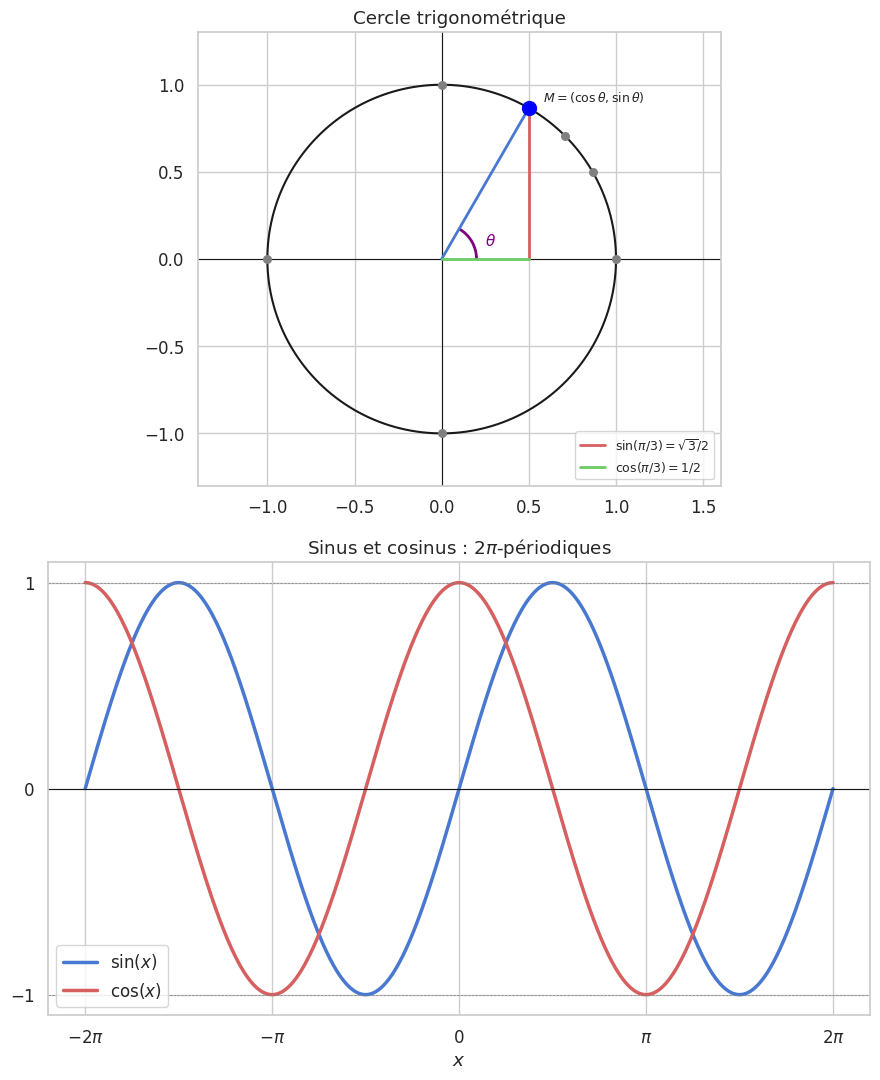
\[\cos x = \sum_{n=0}^{+\infty} \frac{(-1)^n x^{2n}}{(2n)!}, \qquad \sin x = \sum_{n=0}^{+\infty} \frac{(-1)^n x^{2n+1}}{(2n+1)!}.\]

Hide code cell source

fig, axes = plt.subplots(2, 1, figsize=(9, 11))

# Cercle trigonométrique
theta = np.linspace(0, 2*np.pi, 400)
axes[0].plot(np.cos(theta), np.sin(theta), 'k-', linewidth=1.5)
axes[0].axhline(0, color='k', lw=0.8)
axes[0].axvline(0, color='k', lw=0.8)

# Angle remarquable
angle = np.pi / 3
cx, cy = np.cos(angle), np.sin(angle)
axes[0].plot([0, cx], [0, cy], 'b-', linewidth=2)
axes[0].plot([cx, cx], [0, cy], 'r-', linewidth=2, label=f'$\\sin(\\pi/3) = \\sqrt{{3}}/2$')
axes[0].plot([0, cx], [0, 0], 'g-', linewidth=2, label=f'$\\cos(\\pi/3) = 1/2$')
axes[0].scatter([cx], [cy], color='blue', s=100, zorder=5)
axes[0].annotate(f'$M=(\\cos\\theta, \\sin\\theta)$', (cx, cy),
                  textcoords='offset points', xytext=(10, 5), fontsize=9)

# Arc
arc = patches.Arc((0, 0), 0.4, 0.4, angle=0, theta1=0, theta2=60, color='purple', lw=2)
axes[0].add_patch(arc)
axes[0].text(0.25, 0.08, '$\\theta$', fontsize=11, color='purple')

# Angles remarquables
for a, label in [(0,'0'), (np.pi/6,'π/6'), (np.pi/4,'π/4'), (np.pi/3,'π/3'),
                  (np.pi/2,'π/2'), (np.pi,'π'), (3*np.pi/2,'3π/2')]:
    axes[0].scatter([np.cos(a)], [np.sin(a)], color='gray', s=30, zorder=4)

axes[0].set_xlim(-1.4, 1.6)
axes[0].set_ylim(-1.3, 1.3)
axes[0].set_aspect('equal')
axes[0].set_title('Cercle trigonométrique')
axes[0].legend(fontsize=9, loc='lower right')

# Graphes sin et cos
x = np.linspace(-2*np.pi, 2*np.pi, 600)
axes[1].plot(x, np.sin(x), 'b-', linewidth=2.5, label='$\\sin(x)$')
axes[1].plot(x, np.cos(x), 'r-', linewidth=2.5, label='$\\cos(x)$')
axes[1].axhline(0, color='k', lw=0.8)
axes[1].axhline(1, color='gray', lw=0.5, ls='--')
axes[1].axhline(-1, color='gray', lw=0.5, ls='--')

# Marques π
pi_marks = [-2*np.pi, -np.pi, 0, np.pi, 2*np.pi]
pi_labels = ['$-2\\pi$', '$-\\pi$', '$0$', '$\\pi$', '$2\\pi$']
axes[1].set_xticks(pi_marks)
axes[1].set_xticklabels(pi_labels)
axes[1].set_yticks([-1, 0, 1])
axes[1].set_title('Sinus et cosinus : $2\\pi$-périodiques')
axes[1].legend()
axes[1].set_xlabel('$x$')

plt.tight_layout()
plt.show()
_images/484cec897151de969e8f66b78fd1818a446514e22c50cc028120296272e3f3fa.png

Propriétés fondamentales#

Proposition 169 (Propriétés de \(\sin\) et \(\cos\))

  • \(\sin\) et \(\cos\) sont de classe \(\mathcal{C}^\infty\) sur \(\mathbb{R}\), à valeurs dans \([-1, 1]\), \(2\pi\)-périodiques

  • \(\sin' = \cos\) et \(\cos' = -\sin\)

  • \(\sin\) est impaire, \(\cos\) est paire

  • \(\forall x \in \mathbb{R}\), \(\cos^2 x + \sin^2 x = 1\) (relation de Pythagore)

  • \(\sin\) est croissante sur \([-\pi/2, \pi/2]\), \(\cos\) est décroissante sur \([0, \pi]\)

Proposition 170 (Formules d’addition)

\[\cos(a + b) = \cos a \cos b - \sin a \sin b\]
\[\sin(a + b) = \sin a \cos b + \cos a \sin b\]

Proof. Ces formules se démontrent analytiquement en développant \(e^{i(a+b)} = e^{ia} e^{ib}\) (formule d’Euler : \(e^{i\theta} = \cos\theta + i\sin\theta\)) et en identifiant parties réelle et imaginaire. Parties réelles : \(\cos(a+b) = \cos a \cos b - \sin a \sin b\). Parties imaginaires : \(\sin(a+b) = \sin a \cos b + \cos a \sin b\).

Proposition 171 (Formules dérivées)

Duplication :

\[\cos(2a) = \cos^2 a - \sin^2 a = 2\cos^2 a - 1 = 1 - 2\sin^2 a\]
\[\sin(2a) = 2\sin a \cos a\]

Linéarisation :

\[\cos^2 a = \frac{1 + \cos(2a)}{2}, \qquad \sin^2 a = \frac{1 - \cos(2a)}{2}\]

Produit en somme :

\[\cos a \cos b = \frac{\cos(a-b) + \cos(a+b)}{2}, \qquad \sin a \sin b = \frac{\cos(a-b) - \cos(a+b)}{2}\]
\[\sin a \cos b = \frac{\sin(a+b) + \sin(a-b)}{2}\]

Somme en produit :

\[\cos p + \cos q = 2\cos\frac{p+q}{2}\cos\frac{p-q}{2}, \qquad \sin p + \sin q = 2\sin\frac{p+q}{2}\cos\frac{p-q}{2}\]

Proposition 172 (Limite fondamentale)

\[\lim_{x \to 0} \frac{\sin x}{x} = 1.\]

Plus précisément : \(\sin x = x - \dfrac{x^3}{6} + o(x^3)\).

Proof. Par le DL de \(\sin\) (voir chapitre 12) : \(\sin x = x - x^3/6 + O(x^5)\), donc \(\frac{\sin x}{x} = 1 - x^2/6 + O(x^4) \to 1\).

Géométriquement, l’aire du secteur angulaire vaut \(x/2\), comprise entre l’aire du triangle intérieur (\(\sin x \cos x / 2\)) et celle du triangle extérieur (\(\tan x / 2\)), ce qui donne \(\cos x \leq \frac{\sin x}{x} \leq \frac{1}{\cos x}\) pour \(x \in ]0, \pi/2[\), et on conclut par le théorème des gendarmes.

Valeurs remarquables#

Remarque 73

Le tableau suivant est indispensable :

\(x\)

\(0\)

\(\pi/6\)

\(\pi/4\)

\(\pi/3\)

\(\pi/2\)

\(\cos x\)

\(1\)

\(\frac{\sqrt{3}}{2}\)

\(\frac{\sqrt{2}}{2}\)

\(\frac{1}{2}\)

\(0\)

\(\sin x\)

\(0\)

\(\frac{1}{2}\)

\(\frac{\sqrt{2}}{2}\)

\(\frac{\sqrt{3}}{2}\)

\(1\)

\(\tan x\)

\(0\)

\(\frac{1}{\sqrt{3}}\)

\(1\)

\(\sqrt{3}\)

\(-\)

Tangente#

Définition 114 (Tangente)

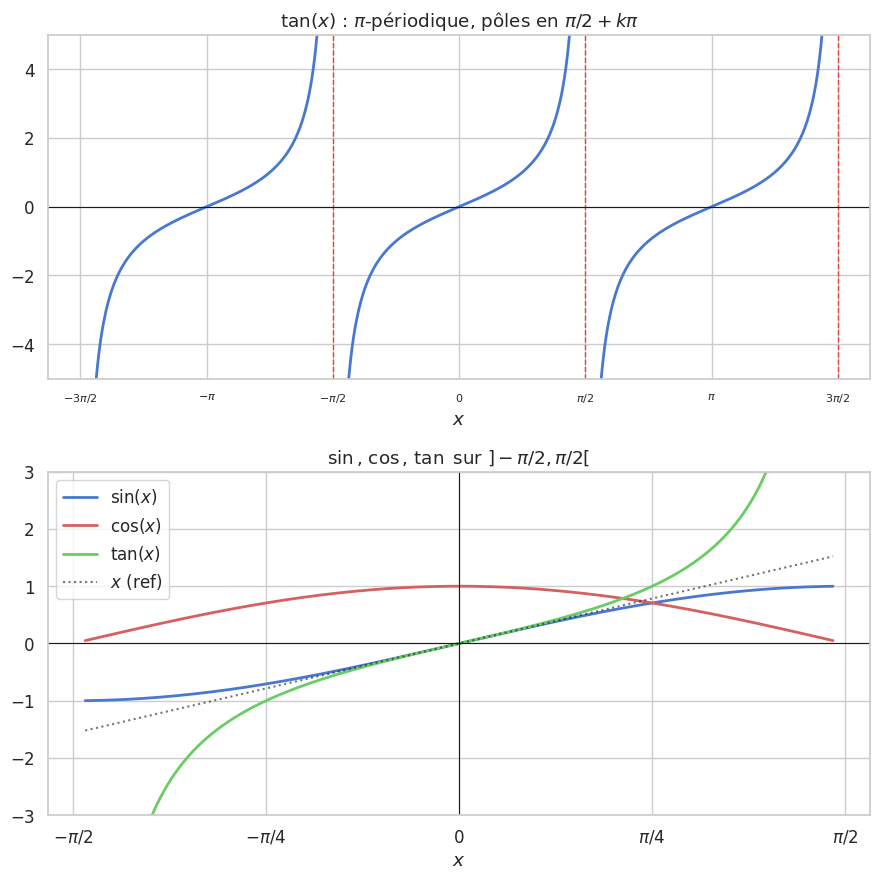
\[\tan x = \frac{\sin x}{\cos x}, \quad \text{définie sur } \mathbb{R} \setminus \left\{\frac{\pi}{2} + k\pi,\; k \in \mathbb{Z}\right\}.\]

Proposition 173

  • \(\tan\) est \(\pi\)-périodique, impaire, de classe \(\mathcal{C}^\infty\) sur son domaine

  • \(\tan' = 1 + \tan^2 = \dfrac{1}{\cos^2}\)

  • \(\tan\) est strictement croissante et convexe sur \(]0, \pi/2[\), strictement concave sur \(]-\pi/2, 0[\)

  • \(\tan\) réalise une bijection de \(]-\tfrac{\pi}{2}, \tfrac{\pi}{2}[\) sur \(\mathbb{R}\)

  • \(\tan(a+b) = \dfrac{\tan a + \tan b}{1 - \tan a \tan b}\) (quand \(\tan a \tan b \neq 1\))

Définition 115 (Formules du demi-angle (substitution \(t = \tan(x/2)\)))

Pour \(x \notin \pi + 2\pi\mathbb{Z}\), en posant \(t = \tan(x/2)\) :

\[\cos x = \frac{1-t^2}{1+t^2}, \qquad \sin x = \frac{2t}{1+t^2}, \qquad \tan x = \frac{2t}{1-t^2}.\]

Proof. \(\cos x = \cos^2(x/2) - \sin^2(x/2) = \cos^2(x/2)(1 - \tan^2(x/2)) = \frac{1 - t^2}{1+t^2}\) en divisant par \(\cos^2(x/2) + \sin^2(x/2)\).
Hide code cell source

fig, axes = plt.subplots(2, 1, figsize=(9, 9))

# Tangente
x_pieces = [np.linspace(-3*np.pi/2 + 0.06, -np.pi/2 - 0.06, 200),
            np.linspace(-np.pi/2 + 0.06, np.pi/2 - 0.06, 200),
            np.linspace(np.pi/2 + 0.06, 3*np.pi/2 - 0.06, 200)]

for piece in x_pieces:
    axes[0].plot(piece, np.tan(piece), 'b-', linewidth=2)

# Asymptotes verticales
for k in [-1, 0, 1]:
    xv = (k + 0.5) * np.pi
    axes[0].axvline(x=xv, color='red', lw=1, ls='--', alpha=0.7)

axes[0].axhline(0, color='k', lw=0.8)
pi_marks = [-3*np.pi/2, -np.pi, -np.pi/2, 0, np.pi/2, np.pi, 3*np.pi/2]
pi_labels = ['$-3\\pi/2$','$-\\pi$','$-\\pi/2$','$0$','$\\pi/2$','$\\pi$','$3\\pi/2$']
axes[0].set_xticks(pi_marks)
axes[0].set_xticklabels(pi_labels, fontsize=8)
axes[0].set_ylim(-5, 5)
axes[0].set_title('$\\tan(x)$ : $\\pi$-périodique, pôles en $\\pi/2 + k\\pi$')
axes[0].set_xlabel('$x$')

# Comparaison sin, cos, tan sur [-π/2, π/2]
x = np.linspace(-np.pi/2 + 0.05, np.pi/2 - 0.05, 400)
axes[1].plot(x, np.sin(x), 'b-', linewidth=2, label='$\\sin(x)$')
axes[1].plot(x, np.cos(x), 'r-', linewidth=2, label='$\\cos(x)$')
axes[1].plot(x, np.tan(x), 'g-', linewidth=2, label='$\\tan(x)$')
axes[1].plot(x, x, 'k:', linewidth=1.5, alpha=0.6, label='$x$ (ref)')
axes[1].set_ylim(-3, 3)
axes[1].axhline(0, color='k', lw=0.8)
axes[1].axvline(0, color='k', lw=0.8)
pi_marks2 = [-np.pi/2, -np.pi/4, 0, np.pi/4, np.pi/2]
axes[1].set_xticks(pi_marks2)
axes[1].set_xticklabels(['$-\\pi/2$','$-\\pi/4$','$0$','$\\pi/4$','$\\pi/2$'])
axes[1].set_title('$\\sin$, $\\cos$, $\\tan$ sur $]-\\pi/2, \\pi/2[$')
axes[1].legend()
axes[1].set_xlabel('$x$')

plt.tight_layout()
plt.show()
_images/0ddec250e5129f4a85230542f5f305d88c334558e456d80ca77eba901630c73c.png

Fonctions trigonométriques réciproques#

Arcsinus#

Définition 116 (Arcsinus)

\(\arcsin : [-1, 1] \to [-\frac{\pi}{2}, \frac{\pi}{2}]\) est la bijection réciproque de \(\sin\!\restriction_{[-\pi/2, \pi/2]}\).

\[y = \arcsin x \iff x = \sin y \text{ et } y \in \left[-\frac{\pi}{2}, \frac{\pi}{2}\right].\]

Proposition 174

  • \(\arcsin\) est impaire, strictement croissante, de classe \(\mathcal{C}^\infty\) sur \(]-1, 1[\)

  • \(\arcsin'(x) = \dfrac{1}{\sqrt{1 - x^2}}\) pour \(x \in \:]-1, 1[\)

  • \(\arcsin(1) = \pi/2\), \(\arcsin(-1) = -\pi/2\)

  • DL en 0 : \(\arcsin x = x + \dfrac{x^3}{6} + \dfrac{3x^5}{40} + O(x^7)\)

Proof. Par dérivation de la réciproque : \(\arcsin'(x) = \dfrac{1}{\sin'(\arcsin x)} = \dfrac{1}{\cos(\arcsin x)}\). Or \(\cos(\arcsin x) = \sqrt{1 - \sin^2(\arcsin x)} = \sqrt{1 - x^2} > 0\) car \(\arcsin x \in ]-\pi/2, \pi/2[\).

Arccosinus#

Définition 117 (Arccosinus)

\(\arccos : [-1, 1] \to [0, \pi]\) est la bijection réciproque de \(\cos\!\restriction_{[0,\pi]}\).

Proposition 175

  • \(\arccos\) est strictement décroissante, de classe \(\mathcal{C}^\infty\) sur \(]-1, 1[\)

  • \(\arccos'(x) = \dfrac{-1}{\sqrt{1 - x^2}}\) pour \(x \in \:]-1, 1[\)

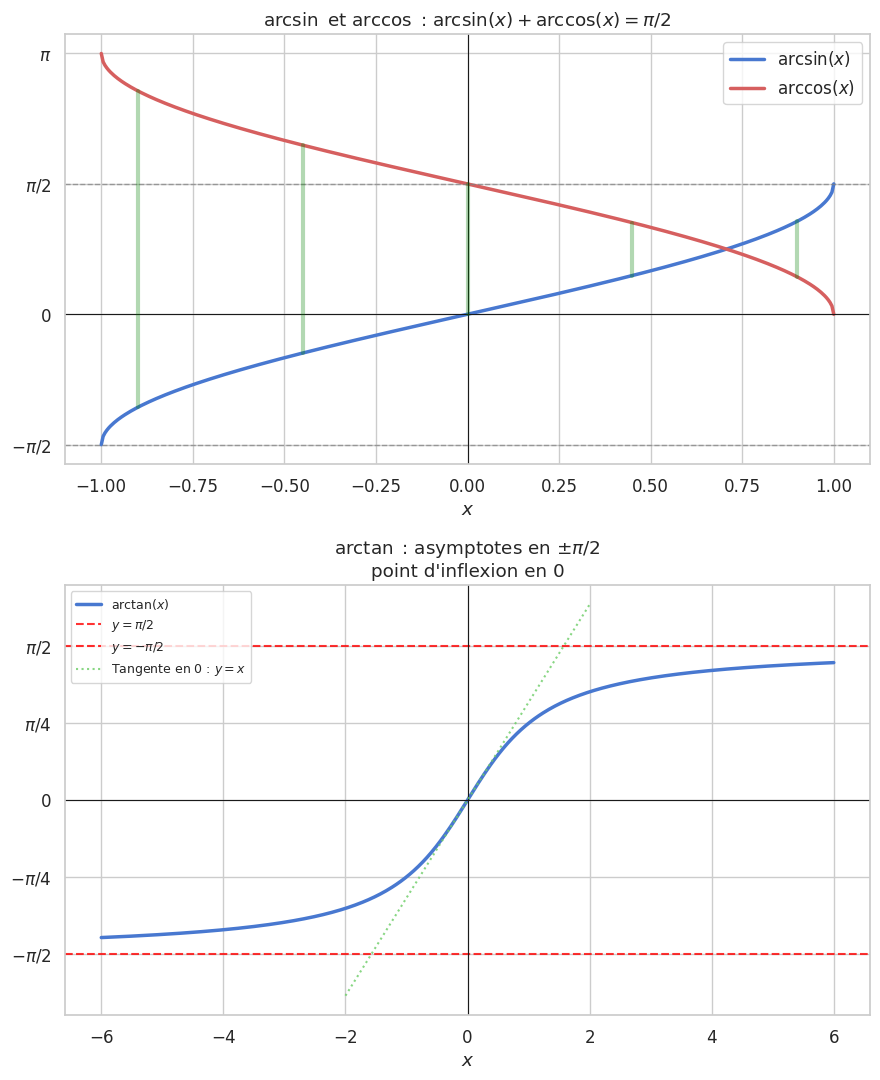
  • \(\forall x \in [-1, 1]\), \(\arcsin x + \arccos x = \dfrac{\pi}{2}\)

Proof. Relation complémentaire : Posons \(g(x) = \arcsin x + \arccos x\). Alors \(g'(x) = 1/\sqrt{1-x^2} - 1/\sqrt{1-x^2} = 0\), donc \(g\) est constante. En \(x = 0\) : \(g(0) = 0 + \pi/2\).

Arctangente#

Définition 118 (Arctangente)

\(\arctan : \mathbb{R} \to ]-\frac{\pi}{2}, \frac{\pi}{2}[\) est la bijection réciproque de \(\tan\!\restriction_{]-\pi/2, \pi/2[}\).

Proposition 176

  • \(\arctan\) est impaire, strictement croissante, de classe \(\mathcal{C}^\infty\) sur \(\mathbb{R}\)

  • \(\arctan'(x) = \dfrac{1}{1 + x^2}\)

  • \(\lim_{x \to +\infty} \arctan x = \dfrac{\pi}{2}\), \(\quad \lim_{x \to -\infty} \arctan x = -\dfrac{\pi}{2}\)

  • \(\arctan\) est concave sur \(\mathbb{R}^+\) et convexe sur \(\mathbb{R}^-\), point d’inflexion en 0

  • DL en 0 : \(\arctan x = x - \dfrac{x^3}{3} + \dfrac{x^5}{5} - \cdots = \sum_{n=0}^{+\infty} \dfrac{(-1)^n x^{2n+1}}{2n+1}\) (pour \(|x| \leq 1\))

Proof. \(\arctan'(x) = \dfrac{1}{\tan'(\arctan x)} = \dfrac{1}{1 + \tan^2(\arctan x)} = \dfrac{1}{1 + x^2}\).

DL : \(\dfrac{1}{1+x^2} = \sum_{n=0}^{N} (-1)^n x^{2n} + O(x^{2N+2})\) par la série géométrique. On intègre terme à terme (justifié par convergence uniforme sur \([-r, r]\), \(r < 1\)).

Remarque 74

La formule de Leibniz : \(\dfrac{\pi}{4} = \arctan 1 = \sum_{n=0}^{+\infty} \dfrac{(-1)^n}{2n+1} = 1 - \dfrac{1}{3} + \dfrac{1}{5} - \cdots\)

La convergence est très lente. En pratique on utilise \(\dfrac{\pi}{4} = \arctan\!\tfrac{1}{2} + \arctan\!\tfrac{1}{3}\) (formule de Machin) pour converger plus vite.
Hide code cell source

fig, axes = plt.subplots(2, 1, figsize=(9, 11))

x = np.linspace(-1.5, 1.5, 500)
x_ext = np.linspace(-6, 6, 500)

# arcsin, arccos sur [-1,1]
x_arc = np.linspace(-1, 1, 400)
axes[0].plot(x_arc, np.arcsin(x_arc), 'b-', linewidth=2.5, label='$\\arcsin(x)$')
axes[0].plot(x_arc, np.arccos(x_arc), 'r-', linewidth=2.5, label='$\\arccos(x)$')
axes[0].axhline(np.pi/2, color='gray', ls='--', lw=1, alpha=0.7)
axes[0].axhline(-np.pi/2, color='gray', ls='--', lw=1, alpha=0.7)
axes[0].axhline(0, color='k', lw=0.8)
axes[0].axvline(0, color='k', lw=0.8)
axes[0].set_yticks([-np.pi/2, 0, np.pi/2, np.pi])
axes[0].set_yticklabels(['$-\\pi/2$', '$0$', '$\\pi/2$', '$\\pi$'])
axes[0].set_title('$\\arcsin$ et $\\arccos$ : $\\arcsin(x)+\\arccos(x)=\\pi/2$')
axes[0].legend()
axes[0].set_xlabel('$x$')
# Visualiser arcsin + arccos = π/2
x_check = np.linspace(-0.9, 0.9, 5)
for xc in x_check:
    axes[0].plot([xc, xc], [np.arcsin(xc), np.arccos(xc)],
                  color='green', alpha=0.3, lw=3)

# arctan
axes[1].plot(x_ext, np.arctan(x_ext), 'b-', linewidth=2.5, label='$\\arctan(x)$')
axes[1].axhline(np.pi/2, color='red', ls='--', lw=1.5, alpha=0.8, label='$y=\\pi/2$')
axes[1].axhline(-np.pi/2, color='red', ls='--', lw=1.5, alpha=0.8, label='$y=-\\pi/2$')
axes[1].axhline(0, color='k', lw=0.8)
axes[1].axvline(0, color='k', lw=0.8)
# Tangente en 0 : y = x
x_tan0 = np.linspace(-2, 2, 100)
axes[1].plot(x_tan0, x_tan0, 'g:', linewidth=1.5, label='Tangente en $0$ : $y=x$', alpha=0.8)
axes[1].set_yticks([-np.pi/2, -np.pi/4, 0, np.pi/4, np.pi/2])
axes[1].set_yticklabels(['$-\\pi/2$', '$-\\pi/4$', '$0$', '$\\pi/4$', '$\\pi/2$'])
axes[1].set_title('$\\arctan$ : asymptotes en $\\pm\\pi/2$\npoint d\'inflexion en 0')
axes[1].legend(fontsize=9)
axes[1].set_xlabel('$x$')

plt.tight_layout()
plt.show()
_images/f6c0de346f250ccf6905dc00bb0963fb419903a2eb2d5360197cbf123cf2198b.png

Fonctions hyperboliques#

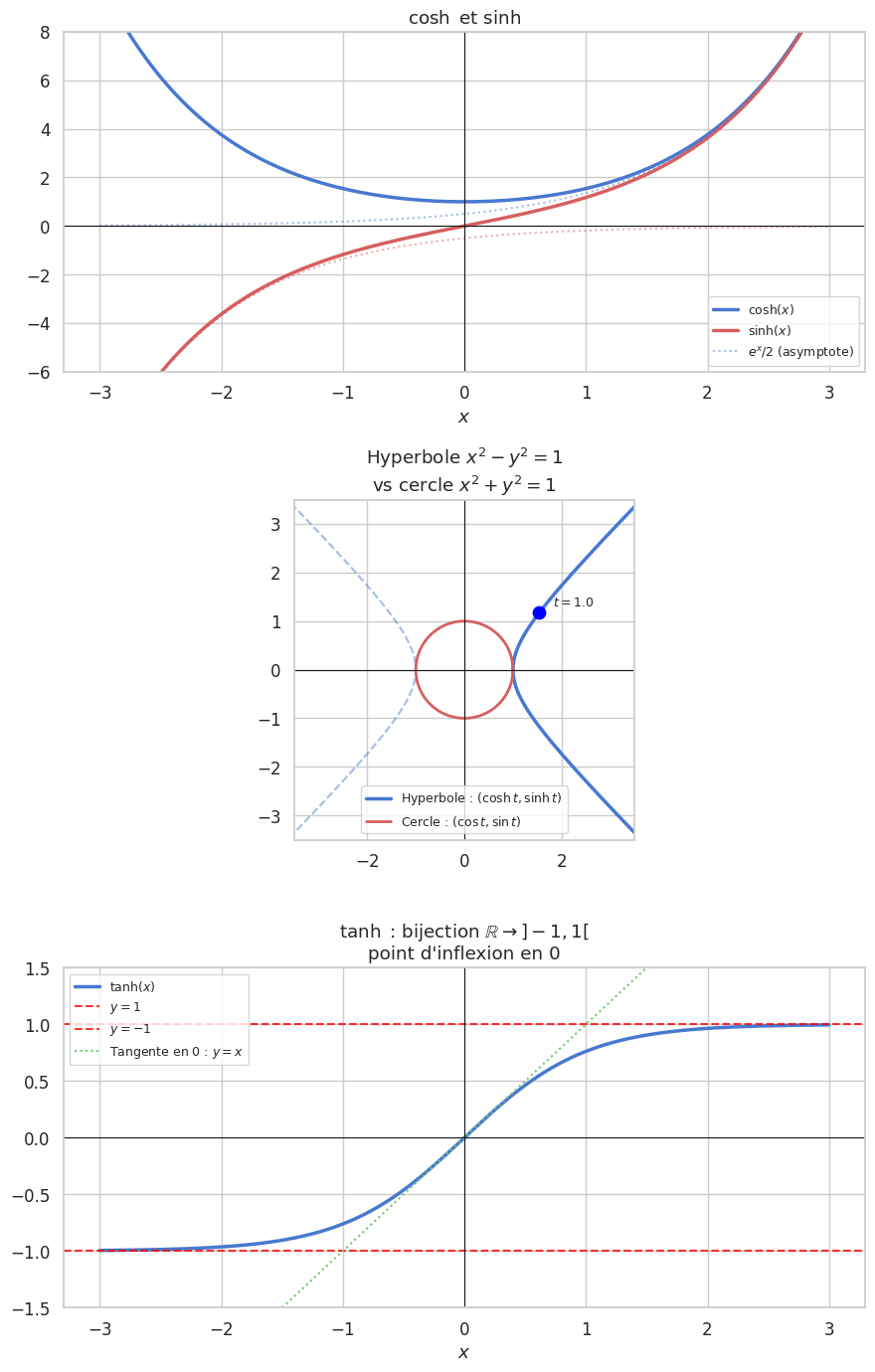
Les fonctions hyperboliques sont les analogues réels des fonctions trigonométriques, mais pour l’hyperbole \(x^2 - y^2 = 1\) au lieu du cercle \(x^2 + y^2 = 1\).

Cosinus et sinus hyperboliques#

Définition 119 (Cosinus et sinus hyperboliques)

\[\cosh x = \frac{e^x + e^{-x}}{2}, \qquad \sinh x = \frac{e^x - e^{-x}}{2}.\]

Remarque 75

Ces fonctions décomposent l’exponentielle en parties paire et impaire :

\[e^x = \cosh x + \sinh x, \qquad e^{-x} = \cosh x - \sinh x.\]

Le point \((\cosh t, \sinh t)\) décrit la branche droite de l’hyperbole \(x^2 - y^2 = 1\), de même que \((\cos t, \sin t)\) décrit le cercle unité. L’angle \(t\) est ici l’aire du secteur hyperbolique (cf. la signification paramétrique).

Proposition 177 (Propriétés de \(\cosh\) et \(\sinh\))

  • \(\cosh\) est paire, \(\sinh\) est impaire

  • \(\cosh' = \sinh\) et \(\sinh' = \cosh\)

  • \(\cosh^2 x - \sinh^2 x = 1\) (identité fondamentale, analogue de \(\cos^2 + \sin^2 = 1\))

  • \(\cosh x \geq 1\) pour tout \(x\), avec égalité uniquement en \(x = 0\)

  • \(\cosh\) est convexe (minimum en 0), \(\sinh\) est convexe sur \(\mathbb{R}^+\) et concave sur \(\mathbb{R}^-\)

  • \(\sinh\) est une bijection strictement croissante de \(\mathbb{R}\) sur \(\mathbb{R}\)

Proof. Identité fondamentale :

\[\cosh^2 x - \sinh^2 x = \frac{(e^x + e^{-x})^2 - (e^x - e^{-x})^2}{4} = \frac{4}{4} = 1.\]

\(\cosh x \geq 1\) : Par l’inégalité arithmético-géométrique : \(\dfrac{e^x + e^{-x}}{2} \geq \sqrt{e^x \cdot e^{-x}} = 1\).

Convexité de \(\cosh\) : \(\cosh'' = \cosh > 0\).

Proposition 178 (Formules d’addition)

\[\cosh(a + b) = \cosh a \cosh b + \sinh a \sinh b\]
\[\sinh(a + b) = \sinh a \cosh b + \cosh a \sinh b\]

Proof. Développer \(\cosh a \cosh b + \sinh a \sinh b = \frac{(e^a+e^{-a})(e^b+e^{-b}) + (e^a-e^{-a})(e^b-e^{-b})}{4} = \frac{2e^{a+b}+2e^{-(a+b)}}{4} = \cosh(a+b)\).

Proposition 179 (Formules de duplication)

\[\cosh(2x) = 2\cosh^2 x - 1 = 1 + 2\sinh^2 x, \qquad \sinh(2x) = 2\sinh x \cosh x.\]

Tangente hyperbolique#

Définition 120 (Tangente hyperbolique)

\[\tanh x = \frac{\sinh x}{\cosh x} = \frac{e^x - e^{-x}}{e^x + e^{-x}} = 1 - \frac{2}{e^{2x}+1}.\]

Proposition 180

  • \(\tanh\) est impaire, de classe \(\mathcal{C}^\infty\), strictement croissante sur \(\mathbb{R}\)

  • \(\tanh' = \dfrac{1}{\cosh^2} = 1 - \tanh^2\)

  • \(\tanh\) est une bijection de \(\mathbb{R}\) sur \(]-1, 1[\)

  • \(\lim_{x \to \pm\infty} \tanh x = \pm 1\) : asymptotes horizontales \(y = \pm 1\)

  • \(\tanh\) est concave sur \(\mathbb{R}^+\), point d’inflexion en 0
Hide code cell source

fig, axes = plt.subplots(3, 1, figsize=(9, 14))

x = np.linspace(-3, 3, 500)

# cosh et sinh
axes[0].plot(x, np.cosh(x), 'b-', linewidth=2.5, label='$\\cosh(x)$')
axes[0].plot(x, np.sinh(x), 'r-', linewidth=2.5, label='$\\sinh(x)$')
axes[0].plot(x, np.exp(x)/2, 'b:', lw=1.5, alpha=0.5, label='$e^x/2$ (asymptote)')
axes[0].plot(x, -np.exp(-x)/2, 'r:', lw=1.5, alpha=0.5)
axes[0].axhline(0, color='k', lw=0.8)
axes[0].axvline(0, color='k', lw=0.8)
axes[0].set_ylim(-6, 8)
axes[0].set_title('$\\cosh$ et $\\sinh$')
axes[0].legend(fontsize=9)
axes[0].set_xlabel('$x$')

# Hyperbole et cercle
t = np.linspace(-2.5, 2.5, 400)
axes[1].plot(np.cosh(t), np.sinh(t), 'b-', lw=2.5, label='Hyperbole : $(\\cosh t, \\sinh t)$')
axes[1].plot(-np.cosh(t), np.sinh(t), 'b--', lw=1.5, alpha=0.5)
theta = np.linspace(0, 2*np.pi, 400)
axes[1].plot(np.cos(theta), np.sin(theta), 'r-', lw=2, label='Cercle : $(\\cos t, \\sin t)$')
# Point particulier
t0 = 1.0
axes[1].scatter([np.cosh(t0)], [np.sinh(t0)], color='blue', s=80, zorder=5)
axes[1].annotate(f'$t={t0}$', (np.cosh(t0), np.sinh(t0)),
                  xytext=(10, 5), textcoords='offset points', fontsize=9)
axes[1].axhline(0, color='k', lw=0.8)
axes[1].axvline(0, color='k', lw=0.8)
axes[1].set_aspect('equal')
axes[1].set_xlim(-3.5, 3.5)
axes[1].set_ylim(-3.5, 3.5)
axes[1].set_title('Hyperbole $x^2-y^2=1$\nvs cercle $x^2+y^2=1$')
axes[1].legend(fontsize=9)

# tanh
axes[2].plot(x, np.tanh(x), 'b-', linewidth=2.5, label='$\\tanh(x)$')
axes[2].axhline(1, color='red', ls='--', lw=1.5, alpha=0.8, label='$y=1$')
axes[2].axhline(-1, color='red', ls='--', lw=1.5, alpha=0.8, label='$y=-1$')
# Tangente en 0 : y = x (car tanh'(0)=1)
x_tan0 = np.linspace(-1.5, 1.5, 100)
axes[2].plot(x_tan0, x_tan0, 'g:', lw=1.5, label="Tangente en $0$ : $y=x$")
axes[2].axhline(0, color='k', lw=0.8)
axes[2].axvline(0, color='k', lw=0.8)
axes[2].set_ylim(-1.5, 1.5)
axes[2].set_title('$\\tanh$ : bijection $\\mathbb{R} \\to ]-1,1[$\npoint d\'inflexion en 0')
axes[2].legend(fontsize=9)
axes[2].set_xlabel('$x$')

plt.tight_layout()
plt.show()
_images/e7abc92d5791e5a8ce092a8051662853e8d8156d654bbae8774c72a3c4f88306.png

Analogie trigonométrique/hyperbolique#

Remarque 76

Le parallèle entre fonctions circulaires et hyperboliques est frappant :

Circulaire

Hyperbolique

\(\cos^2 + \sin^2 = 1\)

\(\cosh^2 - \sinh^2 = 1\)

\(\cos' = -\sin\)

\(\cosh' = \sinh\)

\(\sin' = \cos\)

\(\sinh' = \cosh\)

Cercle \(x^2+y^2=1\)

Hyperbole \(x^2-y^2=1\)

\(e^{ix} = \cos x + i\sin x\)

\(e^x = \cosh x + \sinh x\)

La formule d’Osborn permet de passer d’une identité trigonométrique à son analogue hyperbolique : remplacer \(\sin\) par \(i\sinh\) (ou, pratiquement, changer le signe de chaque produit de deux \(\sinh\)).

Fonctions hyperboliques réciproques#

\(\text{argsinh}\)#

Définition 121

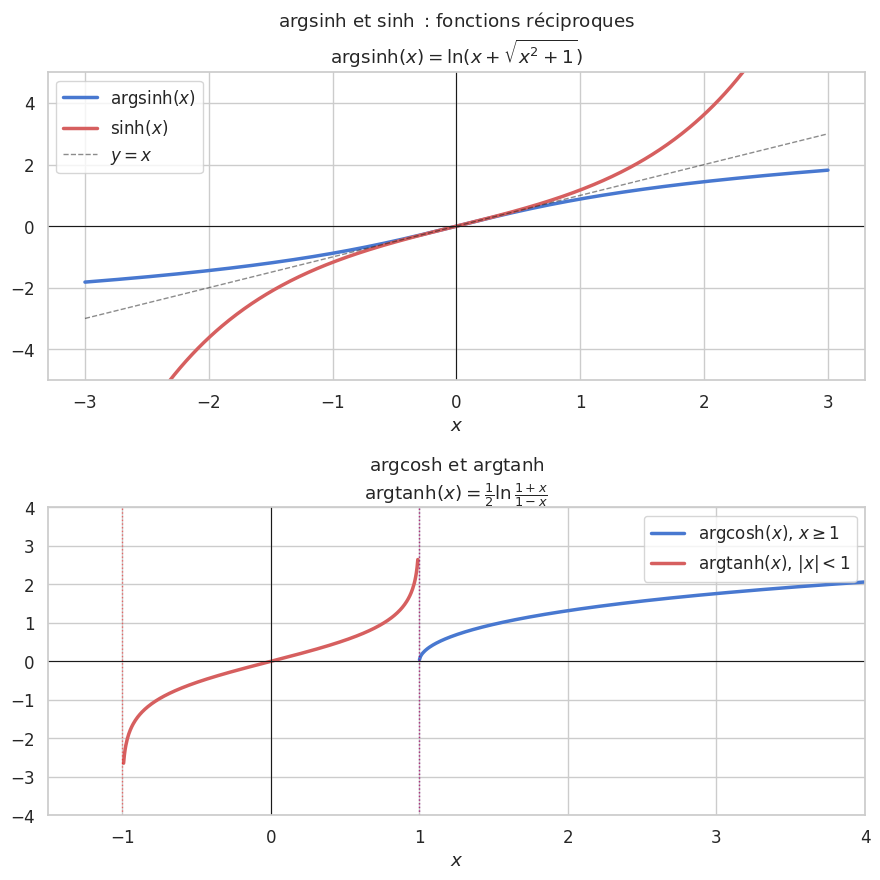
\(\text{argsinh} : \mathbb{R} \to \mathbb{R}\) est la bijection réciproque de \(\sinh\).

Proposition 181

\[\text{argsinh}(x) = \ln\!\left(x + \sqrt{x^2 + 1}\right), \qquad \text{argsinh}'(x) = \frac{1}{\sqrt{x^2 + 1}}.\]

Proof. Expression logarithmique : \(y = \text{argsinh}(x)\) signifie \(x = \sinh y = (e^y - e^{-y})/2\). Posons \(t = e^y > 0\) : \(t^2 - 2xt - 1 = 0\), d’où \(t = x + \sqrt{x^2+1}\) (seule racine positive). Donc \(y = \ln(x + \sqrt{x^2+1})\).

Dérivée : \(\text{argsinh}'(x) = 1/\sinh'(\text{argsinh}(x)) = 1/\cosh(\text{argsinh}(x)) = 1/\sqrt{1 + \sinh^2(\text{argsinh}(x))} = 1/\sqrt{1+x^2}\).

\(\text{argcosh}\)#

Définition 122

\(\text{argcosh} : [1, +\infty[ \to [0, +\infty[\) est la bijection réciproque de \(\cosh\!\restriction_{[0,+\infty[}\).

Proposition 182

\[\text{argcosh}(x) = \ln\!\left(x + \sqrt{x^2 - 1}\right), \qquad \text{argcosh}'(x) = \frac{1}{\sqrt{x^2 - 1}} \quad (x > 1).\]

Proof. \(x = \cosh y = (e^y + e^{-y})/2\) avec \(y \geq 0\). Posant \(t = e^y \geq 1\) : \(t^2 - 2xt + 1 = 0\), d’où \(t = x + \sqrt{x^2-1}\) (la racine \(\geq 1\)). Donc \(y = \ln(x + \sqrt{x^2-1})\).

\(\text{argtanh}\)#

Définition 123

\(\text{argtanh} : ]-1, 1[ \to \mathbb{R}\) est la bijection réciproque de \(\tanh\).

Proposition 183

\[\text{argtanh}(x) = \frac{1}{2}\ln\frac{1+x}{1-x}, \qquad \text{argtanh}'(x) = \frac{1}{1 - x^2}.\]

Proof. \(x = \tanh y\) implique \(e^{2y} = (1+x)/(1-x)\), donc \(y = \frac{1}{2}\ln\frac{1+x}{1-x}\).
Hide code cell source

fig, axes = plt.subplots(2, 1, figsize=(9, 9))

x = np.linspace(-3, 3, 500)
x_pos = np.linspace(1.001, 4, 400)
x_arc_tanh = np.linspace(-0.99, 0.99, 400)

# argsinh et son inverse
axes[0].plot(x, np.arcsinh(x), 'b-', lw=2.5, label='$\\text{argsinh}(x)$')
axes[0].plot(x, np.sinh(x), 'r-', lw=2.5, label='$\\sinh(x)$')
axes[0].plot(x, x, 'k--', lw=1, alpha=0.5, label='$y=x$')
axes[0].axhline(0, color='k', lw=0.8)
axes[0].axvline(0, color='k', lw=0.8)
axes[0].set_ylim(-5, 5)
axes[0].set_title('$\\text{argsinh}$ et $\\sinh$ : fonctions réciproques\n$\\text{argsinh}(x) = \\ln(x+\\sqrt{x^2+1})$')
axes[0].legend()
axes[0].set_xlabel('$x$')

# argcosh et argtanh
axes[1].plot(x_pos, np.arccosh(x_pos), 'b-', lw=2.5, label='$\\text{argcosh}(x)$, $x\\geq 1$')
axes[1].plot(x_arc_tanh, np.arctanh(x_arc_tanh), 'r-', lw=2.5, label='$\\text{argtanh}(x)$, $|x|<1$')
axes[1].axhline(0, color='k', lw=0.8)
axes[1].axvline(0, color='k', lw=0.8)
axes[1].axvline(1, color='blue', ls=':', lw=1, alpha=0.5)
axes[1].axvline(-1, color='red', ls=':', lw=1, alpha=0.5)
axes[1].axvline(1, color='red', ls=':', lw=1, alpha=0.5)
axes[1].set_xlim(-1.5, 4)
axes[1].set_ylim(-4, 4)
axes[1].set_title('$\\text{argcosh}$ et $\\text{argtanh}$\n$\\text{argtanh}(x) = \\frac{1}{2}\\ln\\frac{1+x}{1-x}$')
axes[1].legend()
axes[1].set_xlabel('$x$')

plt.tight_layout()
plt.show()
_images/df1ac351163239ca0df2783957e5bfa82c780c089bbb2d75221b39132a57d420.png

Tableau récapitulatif des dérivées#

Remarque 77

Ce tableau est à connaître absolument.

\(f(x)\)

\(f'(x)\)

Domaine

\(x^n\) (\(n \in \mathbb{Z}\))

\(nx^{n-1}\)

\(\mathbb{R}\) (ou \(\mathbb{R}^*\) si \(n < 0\))

\(x^\alpha\) (\(\alpha \in \mathbb{R}\))

\(\alpha x^{\alpha - 1}\)

\(]0, +\infty[\)

\(e^x\)

\(e^x\)

\(\mathbb{R}\)

\(a^x\) (\(a > 0\))

\((\ln a)\, a^x\)

\(\mathbb{R}\)

\(\ln x\)

\(\dfrac{1}{x}\)

\(]0, +\infty[\)

\(\log_a x\) (\(a>0, a\neq 1\))

\(\dfrac{1}{x\ln a}\)

\(]0, +\infty[\)

\(\sin x\)

\(\cos x\)

\(\mathbb{R}\)

\(\cos x\)

\(-\sin x\)

\(\mathbb{R}\)

\(\tan x\)

\(\dfrac{1}{\cos^2 x} = 1 + \tan^2 x\)

\(\mathbb{R} \setminus \{\frac{\pi}{2} + k\pi\}\)

\(\arcsin x\)

\(\dfrac{1}{\sqrt{1-x^2}}\)

\(]-1, 1[\)

\(\arccos x\)

\(\dfrac{-1}{\sqrt{1-x^2}}\)

\(]-1, 1[\)

\(\arctan x\)

\(\dfrac{1}{1+x^2}\)

\(\mathbb{R}\)

\(\cosh x\)

\(\sinh x\)

\(\mathbb{R}\)

\(\sinh x\)

\(\cosh x\)

\(\mathbb{R}\)

\(\tanh x\)

\(\dfrac{1}{\cosh^2 x} = 1 - \tanh^2 x\)

\(\mathbb{R}\)

\(\text{argsinh}\, x\)

\(\dfrac{1}{\sqrt{x^2+1}}\)

\(\mathbb{R}\)

\(\text{argcosh}\, x\)

\(\dfrac{1}{\sqrt{x^2-1}}\)

\(]1, +\infty[\)

\(\text{argtanh}\, x\)

\(\dfrac{1}{1-x^2}\)

\(]-1, 1[\)

Primitives usuelles#

Remarque 78

Le tableau suivant liste les primitives à connaître, complémentaire du tableau des dérivées.

\(f(x)\)

\(F(x)\) (primitive)

Conditions

\(x^n\) (\(n \neq -1\))

\(\dfrac{x^{n+1}}{n+1}\)

\(\mathbb{R}\) si \(n \in \mathbb{N}\), \(\mathbb{R}^*\) sinon

\(\dfrac{1}{x}\)

$\ln

x

\(e^x\)

\(e^x\)

\(\mathbb{R}\)

\(\cos x\)

\(\sin x\)

\(\mathbb{R}\)

\(\sin x\)

\(-\cos x\)

\(\mathbb{R}\)

\(\dfrac{1}{\cos^2 x}\)

\(\tan x\)

\(x \neq \pi/2 + k\pi\)

\(\dfrac{1}{1+x^2}\)

\(\arctan x\)

\(\mathbb{R}\)

\(\dfrac{1}{\sqrt{1-x^2}}\)

\(\arcsin x\)

\(]-1,1[\)

\(\dfrac{1}{\sqrt{x^2+1}}\)

\(\text{argsinh}\, x\)

\(\mathbb{R}\)

\(\dfrac{1}{\sqrt{x^2-1}}\)

\(\text{argcosh}\, x\)

\(]1,+\infty[\)

\(\dfrac{1}{1-x^2}\)

\(\text{argtanh}\, x\)

\(]-1,1[\)

\(\cosh x\)

\(\sinh x\)

\(\mathbb{R}\)

\(\sinh x\)

\(\cosh x\)

\(\mathbb{R}\)

Hide code cell source

# Vue synthétique : toutes les familles sur un même graphe
fig, axes = plt.subplots(3, 2, figsize=(12, 14))

x = np.linspace(0.01, 4, 400)

# 1. Puissances sur R+
ax = axes[0, 0]
for alpha in [0.5, 1, 2, 3]:
    ax.plot(x, x**alpha, lw=2, label=f'$x^{{{alpha}}}$')
ax.set_xlim(0, 4); ax.set_ylim(0, 8)
ax.set_title('Puissances $x^\\alpha$')
ax.legend(fontsize=9); ax.axhline(0, color='k', lw=0.8)

# 2. Exp et log
ax = axes[0, 1]
x2 = np.linspace(-3, 3, 400)
ax.plot(x2, np.exp(x2), 'b-', lw=2, label='$e^x$')
ax.plot(x[x > 0], np.log(x[x > 0]), 'r-', lw=2, label='$\\ln x$')
ax.set_xlim(-3, 4); ax.set_ylim(-3, 8)
ax.axhline(0, color='k', lw=0.8); ax.axvline(0, color='k', lw=0.8)
ax.set_title('Exponentielle et logarithme')
ax.legend(fontsize=9)

# 3. Trig
ax = axes[1, 0]
x3 = np.linspace(-2*np.pi, 2*np.pi, 600)
ax.plot(x3, np.sin(x3), 'b-', lw=2, label='$\\sin$')
ax.plot(x3, np.cos(x3), 'r-', lw=2, label='$\\cos$')
ax.set_xticks([-2*np.pi, -np.pi, 0, np.pi, 2*np.pi])
ax.set_xticklabels(['$-2\\pi$','$-\\pi$','$0$','$\\pi$','$2\\pi$'])
ax.set_ylim(-1.5, 1.5)
ax.axhline(0, color='k', lw=0.8)
ax.set_title('Sinus et cosinus')
ax.legend(fontsize=9)

# 4. Trig réciproques
ax = axes[1, 1]
x4 = np.linspace(-1, 1, 400)
x4b = np.linspace(-6, 6, 400)
ax.plot(x4, np.arcsin(x4), 'b-', lw=2, label='$\\arcsin$')
ax.plot(x4, np.arccos(x4), 'r-', lw=2, label='$\\arccos$')
ax.plot(x4b, np.arctan(x4b), 'g-', lw=2, label='$\\arctan$')
ax.axhline(np.pi/2, color='gray', ls='--', lw=0.8)
ax.axhline(-np.pi/2, color='gray', ls='--', lw=0.8)
ax.set_ylim(-2, 4)
ax.axhline(0, color='k', lw=0.8); ax.axvline(0, color='k', lw=0.8)
ax.set_title('Trig. réciproques')
ax.set_yticks([-np.pi/2, 0, np.pi/2, np.pi])
ax.set_yticklabels(['$-\\pi/2$', '0', '$\\pi/2$', '$\\pi$'])
ax.legend(fontsize=9)

# 5. Hyperboliques
ax = axes[2, 0]
x5 = np.linspace(-3, 3, 400)
ax.plot(x5, np.cosh(x5), 'b-', lw=2, label='$\\cosh$')
ax.plot(x5, np.sinh(x5), 'r-', lw=2, label='$\\sinh$')
ax.plot(x5, np.tanh(x5), 'g-', lw=2, label='$\\tanh$')
ax.axhline(1, color='g', ls='--', lw=0.8, alpha=0.5)
ax.axhline(-1, color='g', ls='--', lw=0.8, alpha=0.5)
ax.set_ylim(-5, 8)
ax.axhline(0, color='k', lw=0.8); ax.axvline(0, color='k', lw=0.8)
ax.set_title('Fonctions hyperboliques')
ax.legend(fontsize=9)

# 6. Hyperboliques réciproques
ax = axes[2, 1]
x6 = np.linspace(-3, 3, 400)
x6b = np.linspace(1.001, 4, 300)
x6c = np.linspace(-0.99, 0.99, 300)
ax.plot(x6, np.arcsinh(x6), 'b-', lw=2, label='$\\text{argsinh}$')
ax.plot(x6b, np.arccosh(x6b), 'r-', lw=2, label='$\\text{argcosh}$')
ax.plot(x6c, np.arctanh(x6c), 'g-', lw=2, label='$\\text{argtanh}$')
ax.axhline(0, color='k', lw=0.8); ax.axvline(0, color='k', lw=0.8)
ax.set_ylim(-4, 4)
ax.set_title('Hyperboliques réciproques')
ax.legend(fontsize=9)

plt.suptitle('Panorama des fonctions usuelles', fontsize=14, fontweight='bold', y=1.01)
plt.tight_layout()
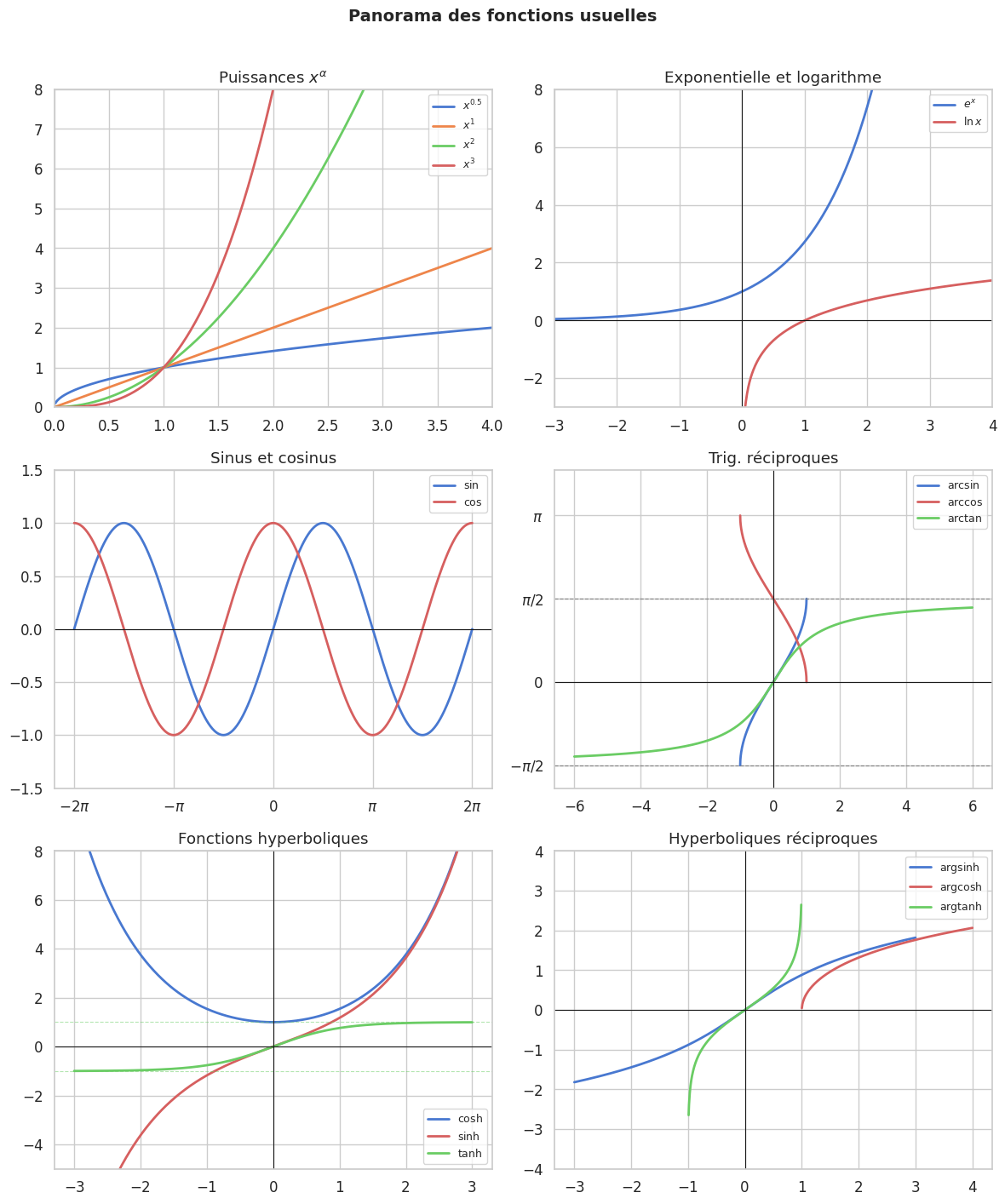
plt.show()
_images/faf45b76ef77f71702aa165daa83dcdc97e8ceaaf38f067a54897b7317d3f16f.png