Probabilités discrètes#
La théorie des probabilités n’est au fond que le bon sens réduit au calcul.
Pierre-Simon de Laplace
Introduction#
Les probabilités formalisent la notion d”incertitude et de hasard. Là où l’analyse étudie des quantités déterministes, la théorie des probabilités étudie des phénomènes dont l’issue n’est pas certaine. Ce chapitre pose les fondements : espaces probabilisés, variables aléatoires discrètes, espérance, variance, et les lois classiques.
Espaces probabilisés#
Définition 272 (Tribu (\(\sigma\)-algèbre))
Soit \(\Omega\) un ensemble (l”univers). Une tribu sur \(\Omega\) est une famille \(\mathcal{A} \subset \mathcal{P}(\Omega)\) vérifiant :
\(\Omega \in \mathcal{A}\)
\(A \in \mathcal{A} \implies \bar{A} = \Omega \setminus A \in \mathcal{A}\)
\((A_n)_{n \geq 1} \subset \mathcal{A} \implies \bigcup_{n=1}^\infty A_n \in \mathcal{A}\)
Remarque 138
Par De Morgan, \(\mathcal{A}\) est stable par intersection dénombrable. Les éléments de \(\mathcal{A}\) sont les événements. En cas discret, on prend \(\mathcal{A} = \mathcal{P}(\Omega)\).
Définition 273 (Probabilité)
Une probabilité sur \((\Omega, \mathcal{A})\) est \(\mathbb{P} : \mathcal{A} \to [0, 1]\) vérifiant :
\(\mathbb{P}(\Omega) = 1\)
\(\sigma\)-additivité : pour \((A_n)\) deux à deux disjoints : \(\mathbb{P}\bigl(\bigcup_{n=1}^\infty A_n\bigr) = \sum_{n=1}^\infty \mathbb{P}(A_n)\)
Le triplet \((\Omega, \mathcal{A}, \mathbb{P})\) est un espace probabilisé.
Proposition 331 (Propriétés fondamentales)
\(\mathbb{P}(\bar{A}) = 1 - \mathbb{P}(A)\)
\(\mathbb{P}(\varnothing) = 0\)
\(A \subset B \implies \mathbb{P}(A) \leq \mathbb{P}(B)\)
\(\mathbb{P}(A \cup B) = \mathbb{P}(A) + \mathbb{P}(B) - \mathbb{P}(A \cap B)\)
Continuité croissante : \(A_n \nearrow A \implies \mathbb{P}(A_n) \to \mathbb{P}(A)\)
Continuité décroissante : \(A_n \searrow A \implies \mathbb{P}(A_n) \to \mathbb{P}(A)\)
Proof. Complémentaire : \(1 = \mathbb{P}(\Omega) = \mathbb{P}(A \sqcup \bar{A}) = \mathbb{P}(A) + \mathbb{P}(\bar{A})\).
Inclusion-exclusion : \(A \cup B = A \sqcup (B \setminus A)\) et \(\mathbb{P}(B \setminus A) = \mathbb{P}(B) - \mathbb{P}(A \cap B)\).
Continuité croissante : \(A_n \nearrow A \implies A = A_1 \sqcup (A_2 \setminus A_1) \sqcup \cdots\), et \(\mathbb{P}(A) = \mathbb{P}(A_1) + \sum_{k \geq 1} \mathbb{P}(A_{k+1} \setminus A_k) = \lim_n \mathbb{P}(A_n)\).
Probabilités conditionnelles et indépendance#
Définition 274 (Probabilité conditionnelle)
Soit \(B\) un événement avec \(\mathbb{P}(B) > 0\). La probabilité de \(A\) sachant \(B\) est
Théorème 72 (Formule des probabilités totales)
Soit \((B_i)_{i \in I}\) un système complet d’événements (deux à deux disjoints, \(\bigcup B_i = \Omega\), \(\mathbb{P}(B_i) > 0\)). Pour tout \(A\) :
Proof. \(A = \bigsqcup_i (A \cap B_i)\), donc \(\mathbb{P}(A) = \sum_i \mathbb{P}(A \cap B_i) = \sum_i \mathbb{P}(A \mid B_i)\mathbb{P}(B_i)\).
Théorème 73 (Formule de Bayes)
Sous les mêmes hypothèses :
Proof. \(\mathbb{P}(B_j \mid A) = \frac{\mathbb{P}(A \cap B_j)}{\mathbb{P}(A)} = \frac{\mathbb{P}(A \mid B_j)\mathbb{P}(B_j)}{\mathbb{P}(A)}\). On remplace \(\mathbb{P}(A)\) par la formule des probabilités totales.
Exemple 152
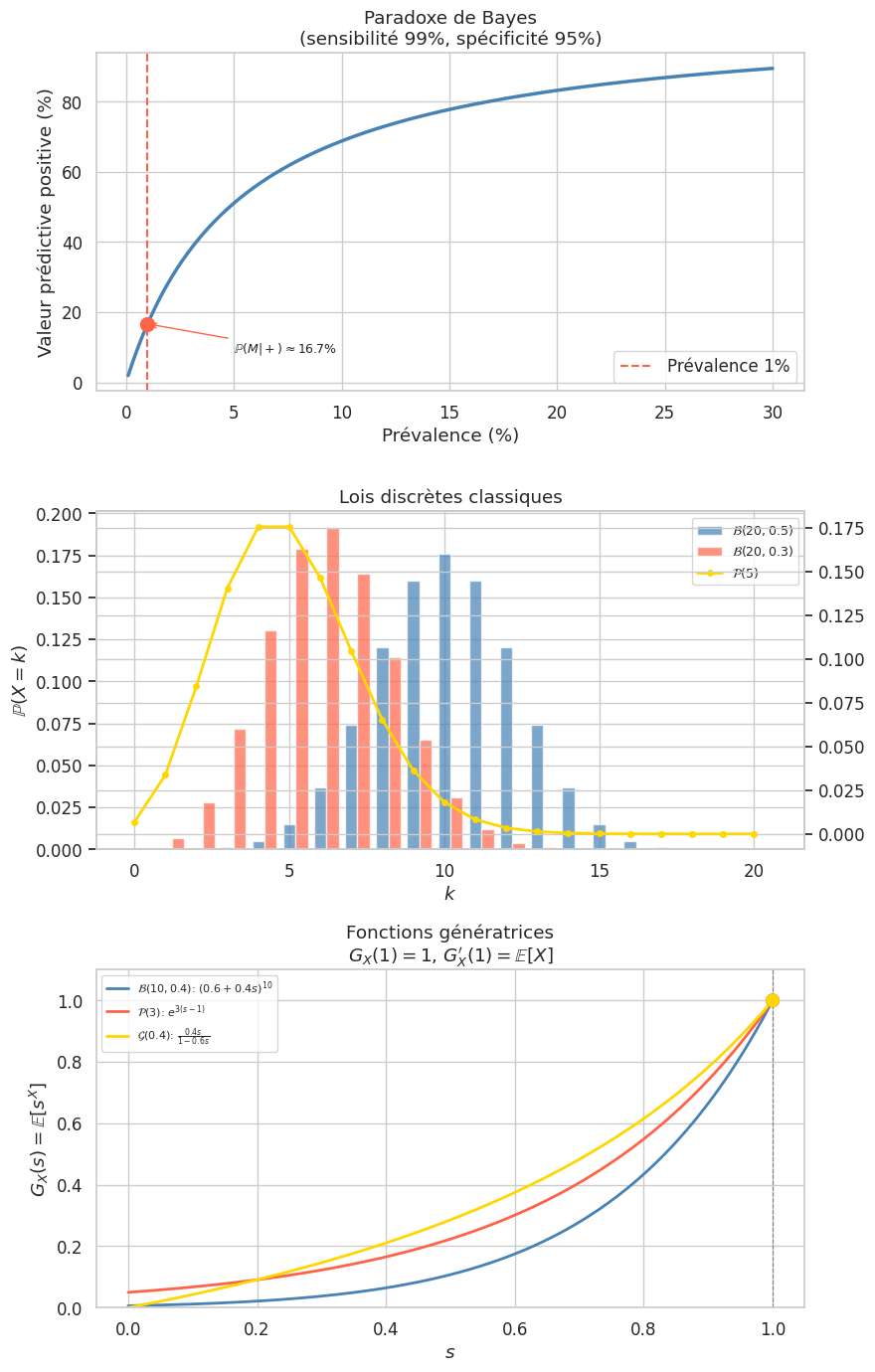
Test médical. Prévalence \(\mathbb{P}(M) = 1\%\). Sensibilité \(\mathbb{P}(+ \mid M) = 99\%\). Spécificité \(\mathbb{P}(- \mid \bar{M}) = 95\%\), donc \(\mathbb{P}(+ \mid \bar{M}) = 5\%\).
Un test positif ne donne que \(\approx 17\%\) de chances d’être malade — résultat contre-intuitif, dû à la faible prévalence.
Définition 275 (Indépendance)
Deux événements \(A, B\) sont indépendants si \(\mathbb{P}(A \cap B) = \mathbb{P}(A) \cdot \mathbb{P}(B)\).
Une famille \((A_i)_{i \in I}\) est mutuellement indépendante si pour toute partie finie \(J \subset I\) :
Remarque 139
L’indépendance deux à deux n’implique pas l’indépendance mutuelle. Contre-exemple (Bernstein) : deux dés, \(A = \{\text{1er pair}\}\), \(B = \{\text{2e pair}\}\), \(C = \{\text{somme paire}\}\).
Variables aléatoires discrètes#
Définition 276 (Variable aléatoire discrète)
Une variable aléatoire discrète est une application \(X : \Omega \to E\) (avec \(E\) dénombrable) mesurable : \(\{X = x\} \in \mathcal{A}\) pour tout \(x \in E\).
La loi de \(X\) est la famille \((\mathbb{P}(X = x))_{x \in E}\), avec \(\sum_{x \in E} \mathbb{P}(X = x) = 1\).
Lois discrètes classiques#
Définition 277 (Lois discrètes fondamentales)
Bernoulli \(\mathcal{B}(p)\) : \(X \in \{0,1\}\), \(\mathbb{P}(X=1) = p\), \(\mathbb{P}(X=0) = 1-p\).
Binomiale \(\mathcal{B}(n,p)\) : \(X \in \{0,\ldots,n\}\), \(\mathbb{P}(X=k) = \binom{n}{k}p^k(1-p)^{n-k}\). Modélise le nombre de succès dans \(n\) épreuves de Bernoulli indépendantes.
Poisson \(\mathcal{P}(\lambda)\) : \(X \in \mathbb{N}\), \(\mathbb{P}(X=k) = e^{-\lambda}\frac{\lambda^k}{k!}\), \(\lambda > 0\). Modélise le nombre d’occurrences d’un événement rare.
Géométrique \(\mathcal{G}(p)\) : \(X \in \mathbb{N}^*\), \(\mathbb{P}(X=k) = (1-p)^{k-1}p\). Modélise le rang du premier succès.
Proposition 332 (Vérification \(\sum \mathbb{P}(X=k) = 1\))
Binomiale : \(\sum_{k=0}^n \binom{n}{k}p^k q^{n-k} = (p+q)^n = 1\).
Poisson : \(\sum_{k=0}^\infty e^{-\lambda}\frac{\lambda^k}{k!} = e^{-\lambda} e^\lambda = 1\).
Géométrique : \(\sum_{k=1}^\infty (1-p)^{k-1}p = p \cdot \frac{1}{1-(1-p)} = 1\).
Proposition 333 (Absence de mémoire de la loi géométrique)
La loi géométrique est l’unique loi discrète vérifiant :
Proof. \(\mathbb{P}(X > k) = (1-p)^k\). Donc \(\mathbb{P}(X > m+n \mid X > m) = \frac{(1-p)^{m+n}}{(1-p)^m} = (1-p)^n = \mathbb{P}(X>n)\).
Unicité : Si \(g(t) = \mathbb{P}(X > t)\) vérifie \(g(m+n) = g(m)g(n)\) avec \(g\) décroissante et \(g(0) = 1\), alors par récurrence \(g(k) = g(1)^k\), ce qui donne la loi géométrique avec \(p = 1 - g(1)\).
Espérance#
Définition 278 (Espérance)
L”espérance de \(X\) est (si la somme converge absolument) :
Théorème 74 (Formule de transfert)
Si \(g : E \to \mathbb{R}\), alors \(\mathbb{E}[g(X)] = \sum_{x \in X(\Omega)} g(x) \cdot \mathbb{P}(X = x)\).
Proposition 334 (Propriétés de l’espérance)
Linéarité : \(\mathbb{E}[\alpha X + \beta Y] = \alpha \mathbb{E}[X] + \beta \mathbb{E}[Y]\) (toujours, sans hypothèse d’indépendance)
Positivité : \(X \geq 0 \implies \mathbb{E}[X] \geq 0\)
Monotonie : \(X \leq Y \implies \mathbb{E}[X] \leq \mathbb{E}[Y]\)
Produit si indépendantes : \(X \perp Y \implies \mathbb{E}[XY] = \mathbb{E}[X]\mathbb{E}[Y]\)
Proposition 335 (Espérances des lois classiques)
Loi |
\(\mathbb{E}[X]\) |
\(\text{Var}(X)\) |
|---|---|---|
\(\mathcal{B}(p)\) |
\(p\) |
\(p(1-p)\) |
\(\mathcal{B}(n,p)\) |
\(np\) |
\(np(1-p)\) |
\(\mathcal{P}(\lambda)\) |
\(\lambda\) |
\(\lambda\) |
\(\mathcal{G}(p)\) |
\(1/p\) |
\((1-p)/p^2\) |
\(\mathcal{U}(\{1,\ldots,n\})\) |
\((n+1)/2\) |
\((n^2-1)/12\) |
Proof. Binomiale : Écrire \(X = X_1 + \cdots + X_n\) avec \(X_i \sim \mathcal{B}(p)\) i.i.d. Par linéarité : \(\mathbb{E}[X] = n\mathbb{E}[X_1] = np\). Pour la variance (indépendance) : \(\text{Var}(X) = n\text{Var}(X_1) = np(1-p)\).
Poisson : \(\mathbb{E}[X] = \sum_{k=1}^\infty k e^{-\lambda}\frac{\lambda^k}{k!} = \lambda e^{-\lambda} \sum_{k=1}^\infty \frac{\lambda^{k-1}}{(k-1)!} = \lambda e^{-\lambda} e^\lambda = \lambda\).
\(\mathbb{E}[X(X-1)] = \lambda^2\) (calcul analogue), donc \(\text{Var}(X) = \mathbb{E}[X^2] - \lambda^2 = \mathbb{E}[X(X-1)] + \mathbb{E}[X] - \lambda^2 = \lambda^2 + \lambda - \lambda^2 = \lambda\).
Géométrique : \(\mathbb{E}[X] = \sum_{k=1}^\infty k(1-p)^{k-1}p = p \cdot \frac{d}{dq}\sum_{k=1}^\infty q^k\big|_{q=1-p} = p \cdot \frac{1}{p^2} = \frac{1}{p}\).
Variance et inégalités#
Définition 279 (Variance)
Lӎcart-type est \(\sigma(X) = \sqrt{\text{Var}(X)}\).
Proof. Formule de König-Huygens : \(\text{Var}(X) = \mathbb{E}[(X-\mu)^2] = \mathbb{E}[X^2 - 2\mu X + \mu^2] = \mathbb{E}[X^2] - 2\mu^2 + \mu^2 = \mathbb{E}[X^2] - \mu^2\).
Théorème 75 (Inégalité de Markov)
Si \(X \geq 0\), alors pour tout \(a > 0\) :
Proof. \(\mathbb{E}[X] = \sum_x x \mathbb{P}(X=x) \geq \sum_{x \geq a} x \mathbb{P}(X=x) \geq a \sum_{x \geq a} \mathbb{P}(X=x) = a\mathbb{P}(X \geq a)\).
Théorème 76 (Inégalité de Bienaymé-Tchebychev)
Proof. Appliquer Markov à \(Y = (X - \mathbb{E}[X])^2 \geq 0\) : \(\mathbb{P}(Y \geq a^2) \leq \mathbb{E}[Y]/a^2 = \text{Var}(X)/a^2\).
Fonctions génératrices#
Définition 280 (Fonction génératrice)
Soit \(X\) à valeurs dans \(\mathbb{N}\). La fonction génératrice est
Proposition 336 (Propriétés)
\(G_X(1) = 1\)
\(G_X'(1) = \mathbb{E}[X]\)
\(G_X''(1) = \mathbb{E}[X(X-1)]\), d’où \(\text{Var}(X) = G_X''(1) + G_X'(1) - (G_X'(1))^2\)
\(G_X\) détermine la loi de \(X\) : \(\mathbb{P}(X = k) = G_X^{(k)}(0)/k!\)
\(X, Y\) indépendantes \(\implies G_{X+Y} = G_X \cdot G_Y\)
Exemple 153
\(\mathcal{B}(p)\) : \(G(s) = q + ps\)
\(\mathcal{B}(n,p)\) : \(G(s) = (q + ps)^n\) (produit de \(n\) Bernoulli indépendantes)
\(\mathcal{P}(\lambda)\) : \(G(s) = e^{\lambda(s-1)}\)
\(\mathcal{G}(p)\) : \(G(s) = \frac{ps}{1 - qs}\) (pour \(|s| < 1/q\))
Somme de Poissons indépendantes : \(X \sim \mathcal{P}(\lambda)\), \(Y \sim \mathcal{P}(\mu)\) indépendantes. \(G_{X+Y}(s) = e^{\lambda(s-1)} \cdot e^{\mu(s-1)} = e^{(\lambda+\mu)(s-1)}\). Donc \(X + Y \sim \mathcal{P}(\lambda + \mu)\).
Couples de variables aléatoires#
Définition 281 (Loi conjointe, marginales, indépendance)
La loi conjointe de \((X, Y)\) : \(\mathbb{P}(X=x, Y=y)\) pour tous \(x, y\).
Les lois marginales : \(\mathbb{P}(X=x) = \sum_y \mathbb{P}(X=x, Y=y)\).
\(X\) et \(Y\) sont indépendantes si \(\mathbb{P}(X=x, Y=y) = \mathbb{P}(X=x) \cdot \mathbb{P}(Y=y)\) pour tous \(x, y\).
Définition 282 (Covariance et corrélation)
Le coefficient de corrélation : \(\rho(X,Y) = \dfrac{\text{Cov}(X,Y)}{\sigma(X)\sigma(Y)} \in [-1, 1]\).
Proposition 337
\(\text{Var}(X + Y) = \text{Var}(X) + \text{Var}(Y) + 2\text{Cov}(X,Y)\)
\(X, Y\) indépendantes \(\implies \text{Cov}(X,Y) = 0\) (non corrélées)
La réciproque est fausse en général
\(|\rho(X,Y)| = 1 \iff Y = aX + b\) p.s. pour des constantes \(a, b\)
Proof. Indépendance \(\implies\) non-corrélation : \(\mathbb{E}[XY] = \sum_{x,y} xy \mathbb{P}(X=x)\mathbb{P}(Y=y) = \left(\sum_x x\mathbb{P}(X=x)\right)\left(\sum_y y\mathbb{P}(Y=y)\right) = \mathbb{E}[X]\mathbb{E}[Y]\).
\(|\rho|=1\) : \(\rho(X,Y)=1 \iff \text{Var}(Y - \frac{\sigma_Y}{\sigma_X}X) = 0 \iff Y = \frac{\sigma_Y}{\sigma_X}X + c\) p.s.
Résumé#
Concept |
Formule / Propriété |
|---|---|
Probabilité |
\(\mathbb{P} : \mathcal{A} \to [0,1]\), \(\sigma\)-additive, \(\mathbb{P}(\Omega) = 1\) |
Prob. conditionnelle |
\(\mathbb{P}(A|B) = \mathbb{P}(A\cap B)/\mathbb{P}(B)\) |
Bayes |
\(\mathbb{P}(B_j|A) \propto \mathbb{P}(A|B_j)\mathbb{P}(B_j)\) |
Espérance |
\(\mathbb{E}[X] = \sum x\mathbb{P}(X=x)\), linéaire |
Variance |
\(\text{Var}(X) = \mathbb{E}[X^2] - \mathbb{E}[X]^2\) |
Markov |
\(\mathbb{P}(X \geq a) \leq \mathbb{E}[X]/a\) |
Tchebychev |
\(\mathbb{P}(|X-\mu| \geq a) \leq \sigma^2/a^2\) |
Binomiale |
\(\mathbb{E}=np\), \(\text{Var}=npq\), \(G=(q+ps)^n\) |
Poisson |
\(\mathbb{E}=\text{Var}=\lambda\), stable par somme |
Géométrique |
\(\mathbb{E}=1/p\), absence de mémoire |
Indépendance |
\(\mathbb{P}(X=x,Y=y)=\mathbb{P}(X=x)\mathbb{P}(Y=y)\) |